





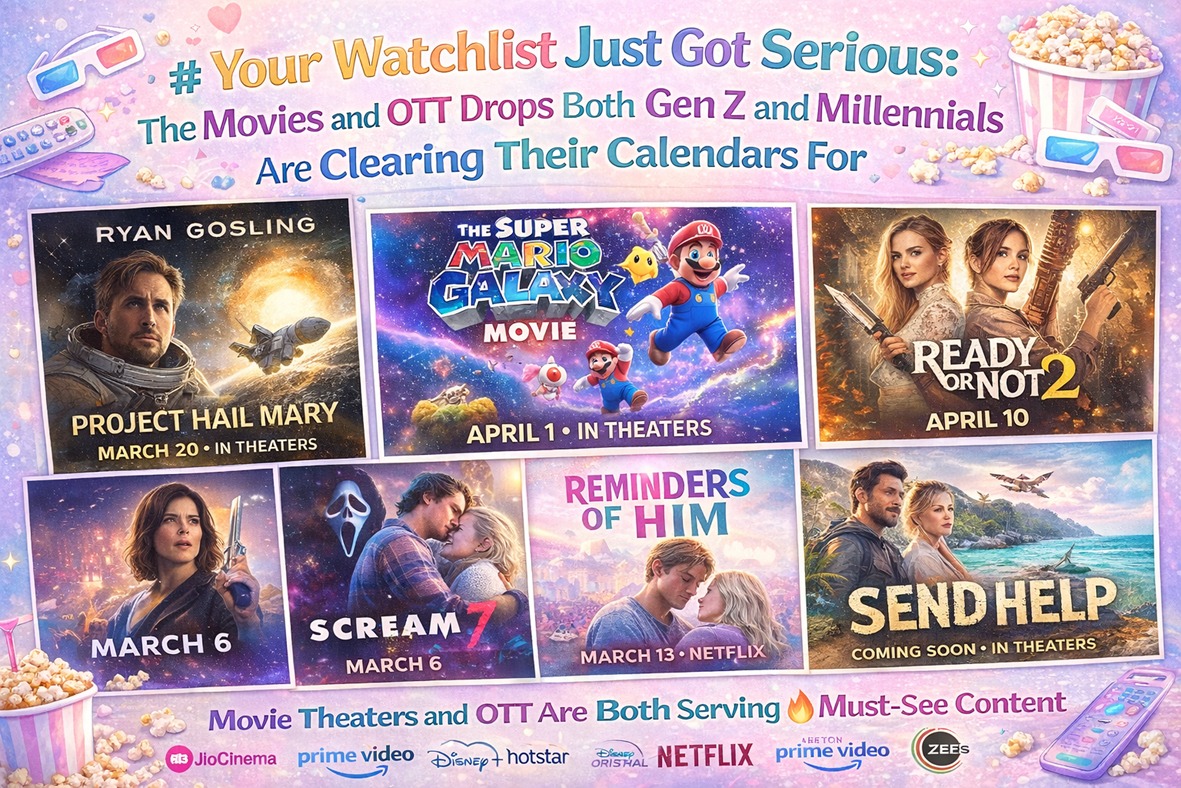
Listen fam, if you thought your streaming subscriptions were just background noise while you scroll through Instagram, 2026 is here to prove you wrong in the best possible way. Right now, as February slides into March and spring beckons, both theaters and OTT platforms are serving content so fire that your weekend plans are about to revolve around release dates instead of club nights. We’re talking Ryan Gosling in space, horror sequels that actually understand the assignment, animated movies that will make you feel things, and Netflix originals starring Matt Damon and Ben Affleck that have already broken the internet before even dropping. This isn’t just another content dump, this is the year where both Millennials and Gen Z finally get entertainment that respects their taste, time, and desperately finite attention spans.
What makes the upcoming lineup particularly special is how it bridges generational preferences without pandering or playing it safe. Millennials who grew up on specific franchises are getting sequels and adaptations that honor what made the originals great while understanding that audiences have evolved. Gen Z, meanwhile, is being served fresh concepts, diverse casting, international content accessibility, and stories that reflect the messy complicated reality of being young in 2026 rather than some sanitized Hollywood fantasy. The diversity spans genres, budgets, languages, and platforms in ways that acknowledge modern viewers consume content across channels without brand loyalty to any single studio or service.
Ryan Gosling is About to Make Science Cool Again with Project Hail Mary
Dropping March 20th in theaters, Project Hail Mary represents everything right about adapting beloved books into movies when you actually respect the source material. Based on Andy Weir’s bestselling novel about an astronaut who wakes up alone on a space station with zero memory of how he got there or why he’s on a mission to the Tau Ceti solar system to stop Earth from sliding into a new ice age, this is the kind of high-concept science fiction that trusts its audience to keep up with actual science instead of dumbing everything down to explosions.
Ryan Gosling starring as Ryland Grace brings serious credibility because let’s be real, this man has never phoned in a performance in his life. From La La Land to Blade Runner 2049 to Barbie proving he can literally do anything, Gosling choosing this project signals that the script is worth the hype. The book itself became a phenomenon among both Millennials who read actual books and Gen Z who discovered it through BookTok recommendations, creating rare cross-generational excitement for a space movie that’s more about problem-solving and science than laser battles.
What makes Project Hail Mary particularly appealing for March release is that it arrives when we’re all desperate for something genuinely smart that makes us think without being pretentious about it. Andy Weir has this gift for explaining complex scientific concepts through character voice and storytelling rather than textbook exposition, and if the movie captures even half of that magic, we’re looking at the kind of film that generates actual conversations beyond just “it was good” or “it sucked.” The Tau Ceti mission setup, the memory-loss mystery, and the gradual reveals about what’s actually happening create natural story momentum that should translate beautifully to screen.
For Millennials who remember when The Martian proved that hard science fiction could be commercially successful and emotionally engaging, Project Hail Mary feels like validation that studios learned the lesson. For Gen Z discovering that space movies can be about more than just Star Wars or Marvel’s cosmic phase, this represents accessible entry into thinking person’s sci-fi. Plus, the March timing means you can actually plan a theater trip with friends without competing against twenty other blockbusters all demanding your opening weekend attendance.
The Super Mario Galaxy Movie Drops April 1st and It’s Not a Joke
After The Super Mario Bros Movie became 2023’s surprise box office phenomenon earning over a billion dollars globally while making Millennials nostalgic and introducing Gen Z to characters through a legitimately good movie rather than that cursed 1993 disaster we don’t talk about, the sequel was inevitable. What wasn’t predictable was the title reveal showing Mario heading to space with The Super Mario Galaxy Movie inspired by the beloved Nintendo Wii title that defined a generation’s platforming experience.
Chris Pratt returns as Mario alongside Anya Taylor-Joy as Peach, Charlie Day as Luigi, Keegan-Michael Key as Toad, and Jack Black as Bowser who absolutely stole the first movie with “Peaches” becoming an actual chart-topping song that nobody saw coming. The fact that the sequel takes inspiration from Super Mario Galaxy specifically matters because that game represents Nintendo at peak creativity, designing entire planets with their own gravity mechanics, absolutely gorgeous visuals for Wii hardware, and gameplay that felt magical in ways that transcended the typical collect-the-coins formula.
For Millennials who played Super Mario Galaxy when it launched in 2007, the nostalgia factor here is absolutely lethal. That game soundtracked college all-nighters, provided stress relief during early career chaos, and created memories of discovering Gusty Garden Galaxy’s orchestral theme or finally beating that one star you’d been stuck on for weeks. Seeing those cosmic concepts translated into Illumination’s animation style with a voice cast that actually works creates genuine anticipation rather than dread about childhood favorites being ruined.
Gen Z’s relationship with Mario is interestingly different, often discovering the character through Super Smash Bros, Mario Kart racing with friends, or the first movie introducing them to the broader Mushroom Kingdom mythology. The Galaxy concept with planets, space exploration, and cosmic-scale adventure feels fresh rather than retreading ground they’ve already seen, making this a sequel that doesn’t require extensive franchise knowledge while rewarding longtime fans with references and Easter eggs. April 1st release means this becomes the early spring blockbuster that dominates conversations, memes, and family viewing plans as weather warms up and people want big joyful entertainment.
Ready or Not 2 Brings Back Samara Weaving for More Chaos
April 10th marks the return of Ready or Not’s twisted game night from hell with Samara Weaving reprising her role as Grace alongside new cast member Kathryn Newton joining the chaos. If you missed the 2019 original, imagine a bride discovering that her wealthy in-laws’ traditional wedding night game is actually a deadly hide-and-seek ritual where the family hunts her through their mansion trying to murder her before dawn. The film became a cult hit for its pitch-black comedy, genuine scares, class commentary wrapped in genre thrills, and Weaving’s absolutely committed performance as a woman who goes from terrified bride to bloodied survivor.
What makes the sequel exciting rather than concerning is that directors Matt Bettinelli-Olpin and Tyler Gillett return, the duo behind the successful Scream reboot and Scream VI proving they understand how to honor horror franchises while bringing fresh ideas. Ready or Not worked because it balanced absurd premise with real stakes, mixing laugh-out-loud moments with genuinely tense sequences where you cared whether Grace survived. The sequel promises more shocking twists and a killer new cast, suggesting they’re expanding the mythology rather than just repeating the same game-night scenario.
For Millennials who grew up on horror that balanced scares with satire like Scream or Tucker and Dale vs Evil, Ready or Not feels like spiritual successor to that tradition of smart genre filmmaking. The class warfare subtext where obscenely wealthy families maintain power through literally sacrificing outsiders resonates particularly hard in 2026 when wealth inequality discussions dominate social discourse. Gen Z’s appreciation for horror that comments on society rather than just providing jump scares makes Ready or Not’s approach feel contemporary rather than dated.
Samara Weaving has become a horror icon between Ready or Not, The Babysitter, and Scream VI, earning genuine fandom beyond just “that actress from that movie” status. Her return signals commitment to the character and story rather than just cashing sequel checks. Kathryn Newton joining as new cast brings her own horror credibility from Freaky and Ant-Man and the Wasp: Quantumania’s action sequences, creating anticipation about what role she plays in the Le Domas family’s twisted traditions.
Neve Campbell Returns in Scream 7 After Sitting Out the Last One
Dropping March 6th, Scream 7 marks Sidney Prescott’s return with Neve Campbell back in the franchise after sitting out Scream VI over pay disputes that resonated throughout Hollywood as important conversation about veteran actresses being valued appropriately. Her return feels significant beyond just franchise continuity because it represents a studio recognizing they made a mistake and correcting it by meeting her demands, setting precedent for how legacy cast members should be treated.
The intrigue around Scream 7 intensifies with Kevin Williamson, who wrote Scream, Scream 2, and Scream 4, stepping into the director’s chair for the first time in the franchise. Williamson created Ghostface’s mythology, wrote the meta-commentary that made Scream more than just slasher movies, and understands these characters at DNA level from having originated them. His transition to directing suggests a vision for where to take the story that requires his specific touch rather than just hiring another capable horror director.
What adds complexity is that Melissa Barrera and Jenna Ortega, who anchored Scream V and VI as the Carpenter sisters, are not returning. Their absence creates questions about how the film bridges between the legacy characters and newer generation while maintaining franchise continuity. For Millennials who grew up with Sidney, Gale, and the original cast, this feels like potentially returning to what made Scream special before it focused on new characters. For Gen Z who discovered Scream through the recent reboots and Jenna Ortega’s star power, the shift requires adjustment but Williamson’s involvement provides assurance that quality remains priority.
Scream has always functioned as commentary on horror genre evolution, with each installment examining how scary movies and audience expectations change over time. Scream 7 arriving in 2026 faces fascinating landscape of elevated horror, trauma-focused narratives, and audiences who’ve seen everything being asked to still find Ghostface threatening. Williamson directing his own script could deliver the kind of sophisticated meta-commentary the franchise is known for while honoring Sidney’s journey toward whatever conclusion feels earned for a character we’ve followed for nearly thirty years.
Colleen Hoover’s Reminders of Him Hits Screens March 13th
The literary adaptation train continues full steam with Reminders of Him, another Colleen Hoover novel getting the screen treatment after It Ends With Us proved that BookTok favorites translate into box office success. Directed by Vanessa Caswill and co-written by Hoover herself as both screenplay writer and producer, the March 13th release caters directly to the massive audience that’s made Hoover the bestselling author phenomenon defining 2020s romance.
For those unfamiliar, Reminders of Him follows a mother released from prison trying to rebuild her life and reconnect with her young daughter while dealing with a community that hasn’t forgiven her past. The story tackles themes of redemption, second chances, judgmental small towns, and complicated romance in ways that Hoover’s fans have embraced while critics debate whether her books glorify problematic relationship dynamics or authentically portray messy human emotions.
What makes this adaptation significant for understanding Gen Z and Millennial viewing habits is how it represents the BookTok-to-screen pipeline that’s reshaped publishing and film industries simultaneously. Hoover’s books became massive through TikTok recommendations, emotional reading videos, and organic fan enthusiasm rather than traditional publishing marketing or Oprah Book Club selections. This grassroots success created built-in audiences for adaptations, with readers eager to see beloved books visualized while bringing friends who haven’t read them but trust the hype.
The casting choices matter tremendously for these adaptations because Hoover readers have extremely specific ideas about who these characters are and how they should be portrayed. Tyriq Withers and Rudy Pankow starring alongside Maika Monroe suggests a mix of rising talent and established actors who can deliver the emotional complexity these stories require. Monroe particularly brings credibility from horror background in It Follows and proven ability to carry emotionally intense narratives.
Hoover’s direct involvement as co-writer and producer addresses concerns about adaptations missing the point or sanitizing aspects that made books resonate. Her participation suggests fidelity to source material that fans care deeply about preserving. For Millennials who might not be core Hoover demographic but are curious about what’s capturing Gen Z’s reading attention, Reminders of Him provides accessible entry to understanding contemporary romance that focuses more on emotional realism than traditional happily-ever-after formulas.
Netflix’s The Rip with Matt Damon and Ben Affleck Already Broke January
Though technically a January 16th release, The Rip continues dominating Netflix’s most-watched lists straight through February and represents the kind of star-powered original content that streaming platforms need to compete with theatrical releases. Matt Damon and Ben Affleck reuniting for a crime thriller directed by Joe Carnahan feels like the kind of mid-budget adult thriller that used to dominate theaters but increasingly finds its home on streaming where economics make more sense.
The plot follows Miami cops who discover millions in cash in a derelict stash house, then watch as trust frays and outside forces learn about the seizure size, creating that tense heist-adjacent thriller energy where you know things will go catastrophically wrong but want to watch the slow-motion disaster unfold. Carnahan’s direction promises the kinetic action sequences and moral complexity he brought to films like Narc and The Grey, elevating this beyond generic corrupt-cop stories.
What makes The Rip fascinating for both generations is how it represents different things to different viewers. Millennials see Damon and Affleck together and immediately recall Good Will Hunting, Ocean’s trilogy, or their general presence defining late-’90s through 2000s Hollywood as serious actors who could also be box office draws. That nostalgia factor combines with current appreciation for crime thrillers that explore systemic corruption rather than glorifying law enforcement.
Gen Z approaches The Rip without decades of context about Damon and Affleck’s careers, judging the film purely on whether the story grabs attention and the performances justify the hype. Netflix’s recommendation algorithm exposing younger viewers to actors they might not have sought out creates interesting viewing patterns where generational touchstone films become discovered content for audiences who weren’t born when they released. The Rip’s continued chart presence suggests it’s connecting across age groups through quality storytelling rather than just banking on star power.
Sam Raimi’s Send Help Proves He Still Got It
Sam Raimi directing Send Help with Rachel McAdams and Dylan O’Brien as plane crash survivors stranded on a deserted island carries significant weight because Raimi essentially invented the horror-comedy genre through Evil Dead franchise before bringing superhero credibility through Spider-Man trilogy and recently directing Doctor Strange in the Multiverse of Madness. His involvement signals this isn’t typical survival movie but something with Raimi’s signature mix of genuine peril and dark humor.
The setup of two colleagues with strained relationship forced to cooperate for survival could go generic quickly, but Raimi’s track record suggests he’ll find unexpected angles that keep things fresh. McAdams brings proven dramatic range from Spotlight and comedy timing from Game Night, while O’Brien has built career balancing action in Maze Runner franchise with comedy in Not Okay, creating promising chemistry potential for characters who need to evolve from professional tension to mutual dependence.
For Millennials who grew up on Raimi’s Spider-Man defining superhero movies before Marvel Cinematic Universe dominated, his return to smaller-scale storytelling feels like opportunity to see what he does when not managing hundred-million-dollar budgets and franchise expectations. Gen Z discovering Raimi through Multiverse of Madness or stumbling onto Evil Dead through horror deep dives gets introduced to a director whose influence shaped modern genre filmmaking even if his name isn’t as immediately recognized as some contemporaries.
The deserted island survival premise also taps into pandemic-era fascination with isolation stories that explore human nature when stripped of societal structures and forced to confront mortality without rescue guaranteed. Send Help arriving in 2026 when we’ve collectively processed COVID trauma could resonate differently than it would have several years ago, with audiences potentially reading metaphorical layers into characters navigating crisis together despite personal conflicts.
Regional Content Dominates OTT While Hollywood Takes Theaters
One trend defining 2026’s entertainment landscape is the complete inversion of traditional distribution wisdom where big-budget Hollywood dominated theaters while regional content stayed in limited release or went straight to OTT. Now, films like The Raja Saab in Telugu are getting massive theatrical runs followed by quick OTT releases that make them accessible nationwide across language barriers through dubbed versions, while Hollywood increasingly sees OTT as equally viable primary release window.
Platforms like JioHotstar, Netflix, Amazon Prime, and Zee5 are aggressively competing for regional content including Tamil, Telugu, Malayalam, and Kannada films that previously struggled to find distribution outside their home states. This creates fascinating viewing patterns where someone in Delhi watches a dubbed Telugu action film they never would have encountered before streaming made it simple as changing audio track, while someone in Hyderabad discovers a Malayalam relationship drama through algorithm recommendation rather than regional preference.
The economic implications matter tremendously for understanding why content diversity has exploded in 2026. Regional films often produced on budgets one-tenth of Bollywood’s big releases can be profitable through combined theatrical run plus OTT rights plus satellite television, creating sustainable ecosystem for storytelling that serves specific audience tastes rather than trying to appeal to everyone. This specialization has elevated quality because filmmakers can commit to their vision rather than diluting it to chase pan-India success.
For Gen Z and Millennials, language is genuinely becoming less of barrier than previous generations experienced. Growing up with subtitled anime, Korean dramas, Spanish series like Money Heist, and global content through streaming platforms has normalized watching entertainment in languages you don’t speak, making regional Indian cinema feel like natural extension of existing viewing habits rather than foreign territory requiring special effort.
The Bottom Line on Your 2026 Watch Calendar
As we navigate through late February into March and beyond, the sheer volume and quality of content demands actual curation rather than passively scrolling through streaming home screens hoping something catches your eye. Project Hail Mary, Super Mario Galaxy, Ready or Not 2, and Scream 7 create legitimate reasons to return to theaters and experience movies with crowds rather than isolated on couches. The Rip, Send Help, and regional OTT releases provide endless home viewing options for nights when leaving the house feels like too much effort but you still want quality entertainment.
What makes 2026 different from previous years is how the content genuinely serves both Gen Z and Millennial preferences without forcing either generation to compromise. Nostalgia-driven sequels and adaptations understand they must deliver for longtime fans while being accessible to newcomers. Original concepts trust audiences to embrace unfamiliar stories rather than requiring franchise recognition to justify existence. Regional content’s mainstream acceptance acknowledges that good storytelling transcends language and geography when platforms make access frictionless.
The investment in both theatrical experiences and streaming content reflects industry recognition that different moods and circumstances demand different viewing options. Sometimes you want that big screen collective experience where audience reactions enhance enjoyment, other times you want to pause whenever necessary, rewind confusing scenes, and watch in pajamas without judgment. Both models can coexist when content quality justifies the delivery method rather than defaulting to one size fits all.
Whether you’re a Millennial finally seeing franchises you care about getting proper treatment, or Gen Z discovering that new releases can actually be worth the hype instead of disappointing, your watchlist in 2026 deserves the same careful curation you give to Spotify playlists or Instagram follows. Book those theater tickets for releases that demand shared experience, queue up OTT content for weekend binges, coordinate viewing parties with friends who appreciate the same genres, and prepare for a year where entertainment actually earns your attention instead of just demanding it. The movies and shows are waiting, the platforms are competing for your time, and your calendar just got a lot more interesting than it was last month.