



He was 27, at the peak of his career, running the hottest show on Indian YouTube, with every celebrity wanting to be in his thumbnail. Then one question — asked by someone else — brought it all down. Fourteen months later, Samay Raina walked back on stage and did the only thing he knows how to do: tell the truth.
Before the Storm: The Making of an Unlikely Star
To understand the magnitude of what Samay Raina lost in February 2025, and what it meant for him to claw it back in April 2026, you have to understand how improbable his rise was in the first place.
Samay Raina was born on 26 October 1997 in Jammu, into a conservative Kashmiri Pandit family from Salia area of Seer Hamdan, Anantnag. The Kashmiri Pandit community carries with it one of modern India’s most painful histories. Samay’s family belongs to the Kashmiri Pandit community, one of hundreds of thousands of Hindus forced to flee the Kashmir Valley in the early 1990s amid widespread violence. Samay was just two years old when his family fled their home in Kupwara.
The family relocated multiple times during the exodus, first moving to Delhi and later settling in Hyderabad. Growing up displaced, between cities and identities, shaped Samay Raina in ways that would surface years later in his comedy — a sharp, self-aware style that used his own biography as raw material, not as a wound to exhibit but as a lens through which to examine everything else.
He was not a child prodigy. He was, by his own account, someone who failed at most things before he found his footing. He turned childhood bullying and academic setbacks into fuel for his comedy and content-creation empire, starting in a below-middle-class Kashmiri Pandit family. He enrolled in a print engineering course at Vidhyarthi Griha’s College of Engineering and Technology in Pune, Maharashtra, which he said was a waste of time, and started doing open mic events and eventually became a regular in the local comedy scene.
After performing at multiple open mics since 27 August 2017, Samay Raina began opening for well-known comedians like Anirban Dasgupta and Abhishek Upmanyu in Pune. There was no overnight success story here — just a young man from Jammu doing five-minute sets in small Pune venues, month after month, slowly building a voice.
The inflection point came in 2019. He became the joint winner of Comicstaan 2 with Aakash Gupta, aired on Amazon Prime Video. The show was India’s answer to a nationwide comedy competition, and winning it — even sharing the crown — gave Samay Raina something no open mic circuit could: national visibility and institutional credibility. He was no longer just a name in Mumbai’s comedy underground; he was a comedian with a mainstream audience.
Then COVID-19 hit and took away the only thing a touring comedian depends on: rooms full of people. What happened next is the episode that truly turned Samay Raina into something culturally distinct. During the COVID-19 pandemic, the government cancelled all outdoor events, and thus, Samay Raina could no longer perform stand-up comedy. He then began streaming chess games on his YouTube channel at the fellow comedian Tanmay Bhat’s suggestion. His viewership boosted when he invited YouTuber Antonio Radić, popularly known as Agadmator, to his channel. In response to this, Indian GM Vidit Gujrathi tweeted that he would like to join Raina on his channel. Eventually, Gujrathi appeared on Raina’s channel, giving another boost to Raina’s viewership.
What Samay Raina built during the pandemic was genuinely novel — a comedy-chess ecosystem that brought grandmasters and stand-ups into the same frame, made chess thrillingly watchable for millions of young Indians who had never played the game, and created a community built on laughter and intellectual engagement simultaneously. He collaborated with Viswanathan Anand, streamed with Magnus Carlsen, and organised his own tournaments with prize pools and charity components. He won the $10,000 Botez Bullet Invitational in 2021 — the only Indian streamer competing among top international Twitch streamers — and donated a significant portion to charity. When the comedy world reopened, Raina emerged from the pandemic not just having survived, but having invented an entirely new audience for himself.
By 2026, Samay Raina had amassed 7.37 million subscribers and 644 million views on his YouTube channel. He had become one of the most-watched digital creators in India, with a loyal audience that spanned comedy fans, chess enthusiasts, and people who simply found him funny, honest, and real. His influence had stretched well beyond the comedy community. Celebrities sought him out. Every video he posted pulled between five and six crore views. He was, as he himself would later describe on stage, having “such a great life going on till January 2025.”
India’s Got Latent: The Show That Changed Everything
In June 2024, Raina launched the most ambitious project of his career. India’s Got Latent was an Indian Hindi-language talent show hosted by Samay Raina on YouTube from 2024 to 2025. Inspired by the international Got Talent franchise and Kill Tony, it featured a wide variety of acts including singing, dancing, magic, and comedy. The format was brilliantly conceived: contestants from across the country would perform 90-second acts before a panel of celebrity judges, rating themselves before they performed, and if the judges’ average rating matched their self-assessment, the contestant won the full proceeds from that day’s ticket sales.
The show was raw, unscripted, anarchic, and frequently hilarious. It did something Indian entertainment had rarely done: it celebrated failure with the same energy as success, and it created a space where genuinely bizarre, niche, and unconventional talent could exist without being sanitised for primetime television. India’s Got Latent quickly became the talk of digital India — discussed in every comedy circle, shared across every social media platform, dissected on podcasts. Episodes regularly pulled in millions of views. An accompanying India’s Got Latent app briefly topped both the Apple App Store and Google Play Store charts. The show was a commercial juggernaut, reportedly earning Samay between ₹1.5 crore to ₹2.5 crore monthly through YouTube ad revenue and memberships alone.
Samay Raina brought in celebrity guests as judges — comedians, YouTubers, influencers, and figures from the digital entertainment world. The show created stars of its own. It felt, to many observers, like the early days of something transformative: a genuinely Indian, genuinely digital, genuinely unbothered form of entertainment that didn’t need a broadcasting licence or a television network’s approval to exist and thrive.
Then came February 2025.
The Controversy: One Question, a National Firestorm
On 10 February 2025, podcaster Ranveer Allahbadia, popularly known as BeerBiceps, appeared as a guest judge in the sixth bonus episode alongside YouTuber Ashish Chanchlani, social media influencer Apoorva Mukhija, and Jaspreet Singh. During the episode, Allahbadia made a remark that sparked widespread controversy. He asked a contestant: “Would you rather watch your parents have sex every day for the rest of your life or join in once to make it stop forever?”
The question — crude, sexually explicit, involving parents — was not the kind of edgy humour that earns respectful cringes and moves on. It went viral with the speed and force of true outrage. The clip was shared everywhere. Reactions were furious. The National Commission for Women (NCW) intervened. Politicians across parties condemned it. And within days, a show that had been India’s most exciting piece of digital entertainment became a legal emergency.
On 10 February 2025, Guwahati Police registered an FIR against five creators for “promoting obscenity,” citing multiple sections of the Bharatiya Nyaya Sanhita, 2023, the Cinematograph Act, 1952, and the Indecent Representation of Women (Prohibition) Act, 1986. Maharashtra Cyber Department followed suit, booking them under multiple BNS sections and Section 67 of the Information Technology Act, 2000. FIRs were also filed in Rajasthan. Politicians publicly weighed in on the case across multiple states, and Samay Raina ultimately deleted all episodes of India’s Got Latent in an effort to cooperate and ease the controversy.
Raina’s decision to delete all episodes was not taken calmly or voluntarily. In his later special, he would reveal the detail that explained why he had no real choice. Inside The Habitat, Balraj’s parents, who are in their 70s, simply ran the comedy club where they used to shoot. They were found falling at the feet of young police officers, pleading, “Sir, please let us go, we haven’t done anything.” Watching that video completely broke him, and he couldn’t stop crying.
The episode with Allahbadia had been filmed on November 14, 2024 and aired on February 8, 2025, on a members-only section of Raina’s channel. It then leaked beyond that paywall and into the broader internet. But here is the detail Samay Raina would later reveal that significantly complicates the narrative of his own responsibility: in his Still Alive special, he revealed that Ranveer asked the contentious question eight times during the filming of the episode, alongside several other inappropriate prompts. Raina had edited all other instances out and kept only one in the final video. His decision to keep even one was one he would spend fourteen months reckoning with.
The controversy went beyond just Allahbadia’s question. During one of the performances, some contestants endorsed derogatory remarks about guest judge Urfi Javed, including “slut-shaming” her and comparing her with an adult actress, which eventually led to her walking off the show. The show’s main judge Samay Raina didn’t intervene. A separate but connected legal proceeding followed: the Supreme Court of India directed Samay Raina and four other comedians to post unconditional public apologies on social media for ridiculing persons with disabilities on the show, and to host at least two events per month featuring persons with disabilities, including those with rare disorders.
Both Samay and Ranveer later issued public apologies. Samay submitted an affidavit to the Supreme Court expressing remorse and a commitment to more responsible content, pledging to uphold “better conduct, content sensitivity, and legal compliance” moving forward.
What followed for Samay Raina personally was, by his own account, a psychological unravelling. Raina describes his emotional toll in stark terms. He recalls shivering backstage, his heart racing and breathing shallow before a show — classic signs of an anxiety attack. He began receiving abusive messages and death threats online, including images targeting his parents.
“I swear to God I felt like it was a dream, it wasn’t real… It’s called psychosis,” he said. He revealed he nearly lost ₹8 crore — money planned for building a house and other life goals — had he been forced to pull out of his US tour at that moment. He also revealed he took half a bottle of melatonin (36 tablets) to sleep and often had anxiety attacks during the worst of the fallout.
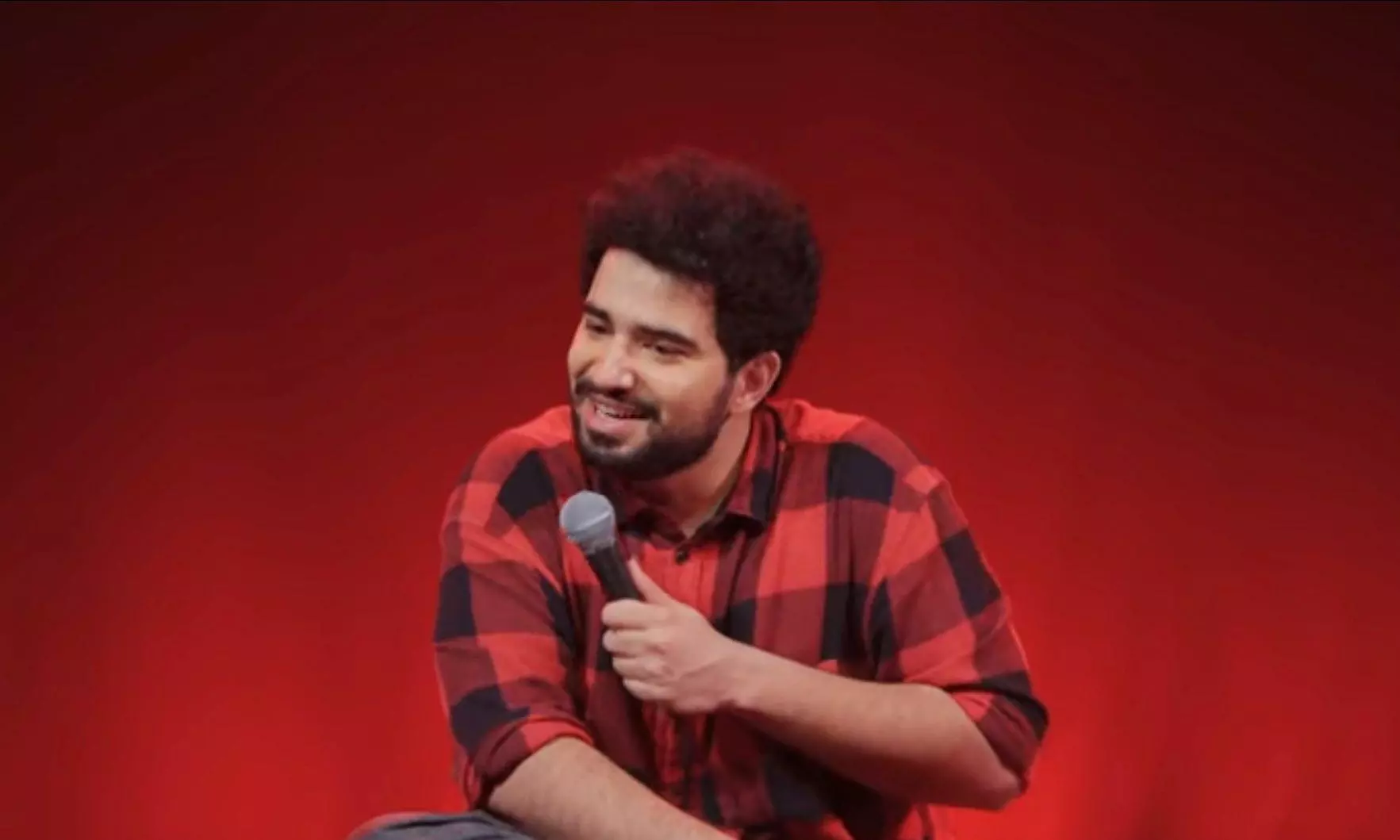
What made this particularly cruel was the position Raina found himself in. He had not made the question. He had edited out seven instances of it and left in one. He was the host, not the perpetrator. But in the logic of public outrage — and of FIR law — proximity to the moment was treated as responsibility for it. He was the person whose name was on the show, whose face anchored every episode, and whose channel had given the moment a platform.
The Silence: Fourteen Months of Nothing
Between February 2025 and April 2026, Samay Raina went silent on the topic of India’s Got Latent. He did not disappear entirely — the special was filmed during his global Still Alive & Unfiltered tour, which ran from August 2025 to early 2026. The tour saw Raina perform across major international venues, including the Madison Square Garden Theatre in New York, a milestone that places him among the youngest Indian comedians to take that stage. He also won the SuperPogChamps chess tournament hosted by Chess.com in December 2025, donating the $10,000 prize to charity.
But on the subject of India’s Got Latent, on Ranveer Allahbadia, on the FIRs, on the nights he couldn’t sleep — nothing. The silence was strategic and personal simultaneously. It was the discipline of a performer who knew that the only stage worth explaining himself on was one where he controlled the terms.
During this period, in November 2025, Samay Raina revealed that he was planning to renew the show for a second season. The signal was clear to those paying attention: he had not been broken permanently. He had merely withdrawn to regroup.
Still Alive: The Return on Samay Raina’s Own Terms
On April 7, 2026, Samay Raina ended his months-long public hiatus by uploading a 1-hour and 21-minute stand-up special titled “Still Alive” to his official YouTube channel. Written and performed by Samay Raina and directed by Karan Asnani, the video directly addresses the fallout from the catastrophic India’s Got Latent controversy of early 2025.
The choice of medium is itself a statement. He did not go on a podcast to be interviewed. He did not write a Medium essay. He did not appear on a celebrity chat show to be gently probed by a friendly host. He went back on stage — his stage, on his channel, on his terms — and did what he has always done: performed his way through the truth.
The special opens with a question that is as old as the art of public apology itself. Invoking the presence of George Orwell, Samay Raina started the topic by asking his audience: “As a comedian, do I apologise or not?” It is a structurally perfect opening — because the answer he gives is neither a simple yes nor a simple no. It is a comedian’s answer: complicated, self-aware, and delivered in front of an audience who has to feel the weight of the question alongside him.
He named names — something that required either courage or the confidence that comes from having already survived the worst. Taking a dig at comedian Sunil Pal, Raina recalled how he learned from fellow comedian Kapil Sharma, ironically someone who was set to appear on the show soon after. He didn’t hold back while addressing others either, including singer B Praak and actor Mukesh Khanna, whom he accused of seeking attention during the uproar.
Talking about the impact on his mental health, he said about Allahbadia: “At least he knows meditation. I don’t know anything. Beer Biceps… the monk who sold my Ferrari.” The line is a masterpiece of the form: a dig, a confession, and a philosophical observation compressed into a single sentence.
He also addressed, in full, his Kashmiri identity — the thread that runs beneath his entire public persona but that he rarely makes the explicit subject of his comedy. Samay Raina referenced his Kashmiri identity to crack a few jokes. The comedian said that he got dragged in even though he didn’t make the statement. “Hum Kashmiri crossfire me hi marte hain (We, Kashmiris, always die in the crossfire),” he said, and went on to share what he described as “Kashmiri Pandit wisdom”: “Only fight when the fight is fair. When you have a chance of winning.
When the fight is not fair, you f**k off from there.” For a Kashmiri Pandit — a community whose defining historical experience is exactly this: leaving rather than staying for a fight they could not win — it is a line that operates on multiple levels simultaneously. It is self-deprecating, politically charged, historically resonant, and genuinely funny. It is, in other words, exactly what good comedy is supposed to be.
He defended Apoorva Mukhija, the female influencer who had appeared on the show and faced the sharpest online harassment in its wake. Samay narrates how a contestant on India’s Got Latent allegedly hurled a sexist line at Apoorva, and instead of staying silent, Apoorva replied sharply in the same tone, flipping the moment in front of the cameras.
Samay frames that exchange as a rare instance of pushback within a strongly patriarchal space, saying, “In this patriarchal setup, where no one expects women to say anything, that girl replied in his own language. She won. He lost.” It is a moment in the special that generated significant response online — a male comedian, in the middle of explaining his own crisis, choosing to spend time defending a woman who had been subjected to a sustained campaign of misogynistic abuse. It matters.
And then, at the end: the special ends with Samay announcing that India’s Got Latent Season 2 is in the works, confirming that the format will return despite past storms. He even joked about experimenting with formats, including removing audience phones and introducing more provocative interactions, suggesting that unpredictability will remain central to the show’s identity.
After the response, Samay took to his Instagram story and wrote, “Overwhelmed by the response to my new special — Still Alive.” His mother celebrated as the special received a massive audience response. The comeback had landed.
The Anatomy of a Cancellation — and Why This One Failed
India’s Got Latent and the controversy surrounding it prompted a fierce national debate about comedy, the limits of free speech, and the power of online outrage. But Raina’s eventual return also raises an important analytical question: why did the “cancellation” not stick?
Cancellations succeed, when they do, because they permanently alter the relationship between a creator and their audience. What happened in Raina’s case was more complex. The audience for India’s Got Latent had always known what they were signing up for — unfiltered, uncurated, frequently transgressive humour, performed in a room that operated by different rules than primetime television. The rage that descended on the show came disproportionately from people who had not been watching it. Sentiment on r/IndiasGotLatent skewed strongly supportive of Raina’s comeback, with threads treating Samay Raina sympathetically as someone partly caught in a co-creator’s mistake significantly outnumbering those focused purely on his own accountability.
The controversy also suffered from a credibility gap in its most vocal critics. According to Hindustan Times, Raina said directly that Ranveer Allahbadia had jeopardised the future of comedy through his conduct, framing the damage not just as personal but as affecting an entire generation of creators who had been building something new in Indian digital entertainment. The fact that Samay Raina himself was willing to be publicly critical of the person most responsible — while simultaneously defending the format and the intent of the show — gave him a moral authority that a simple “I’m sorry” would never have provided.
There is also the question of what happens when the state enters the room. The involvement of police across multiple states — including the arrest of the editor of the comedy venue and the sight of elderly parents on their knees before young police officers — created sympathy for Raina in audiences who might otherwise have been ambivalent. In India, the heavy hand of law enforcement in matters of online expression has a long and documented history of overreach. Many of those who watched the controversy unfold — even those who had initially been critical — found the spectacle of FIRs being filed across three states over a YouTube comedy show to be disproportionate.
The Broader Stakes: What the IGL Controversy Revealed About Indian Comedy
India’s Got Latent was not just a television show with a controversy. It was a mirror held up to the state of free expression in Indian digital entertainment, and the cracks it revealed were significant.
The show existed in a regulatory grey zone. It was not broadcast television, not OTT in the traditional sense, and not subject to the content guidelines that govern licensed platforms. It was YouTube — the internet’s oldest and most anarchic stage. The Supreme Court of India, while refraining from passing any final judgment on content regulation, indicated the need for effective regulatory measures that balance societal morality with the constitutional right to free speech under Article 19(1)(a). The case became a proxy for a much larger debate: who gets to decide what is permissible comedy in India, and who enforces those limits?
The involvement of politicians was particularly instructive. Multiple state governments — some from different parties — rushed to file FIRs or make statements about the show. Assam Chief Minister Himanta Biswa Sarma also announced that an FIR had been filed by the Guwahati police against the individuals involved in the incident for promoting obscenity.
The speed with which elected officials entered a comedy controversy — not because they had been watching the show, but because the moment offered political capital — is revealing. In India, comedy that touches on institutions, religion, or public morality has always carried a legal risk that is fundamentally different from its equivalent in, say, the United Kingdom or Canada. Samay Raina’s case crystallised this in a way that no amount of academic discussion about creative freedom could.
There is also the question of what the controversy did to the ecosystem of Indian digital comedy more broadly. India’s Got Latent had been pulling in millions of views, creating a market for unscripted, risk-taking comedy on YouTube. The fallout — the FIRs, the police visits, the Supreme Court proceedings — sent a chilling signal to every creator in that space. If the most popular comedy show on Indian YouTube could be taken down overnight by a guest’s one remark, what protection did anyone else have?
The answer, in the short term, was: almost none. Several creators became noticeably more cautious in the months that followed. The format of IGL — raw, unscripted, with rotating celebrity panellists saying whatever came to mind — became more difficult to replicate once it had been demonstrated that the consequences of one bad moment could be legal, financial, and existential.
The Future of Comedy in India: The Stakes of Samay Raina’s Return
Raina’s comeback with Still Alive, and his announcement of India’s Got Latent Season 2, is therefore not just a story about one comedian’s personal redemption. It is a statement about what kind of comedy India’s digital space is willing to sustain.
The special itself models something important: that it is possible to be funny and honest about a serious mistake simultaneously. That accountability and artistry are not mutually exclusive. That a comedian can say “I got this wrong, here’s how, here’s what it cost me, here’s what I’d do differently” — and still hold the room. This is not a small thing in an Indian entertainment culture that tends to default to either complete apology-and-erasure or defiant denial. Samay Raina chose a third path: transparency, performed at full volume, with jokes.
The new season is expected to push boundaries further, with a “wild” version of the show planned, while a comparatively toned-down version may be released online. The dual-format strategy is itself an acknowledgment of the regulatory landscape: different rules for different platforms, different audiences, different risk tolerances. It suggests Raina has done the thinking required to understand not just what happened but why — and to build a structure that can survive future turbulence.
The broader landscape of Indian comedy is, despite the controversy, healthier in terms of audience size and appetite than it has ever been. The streaming boom — Netflix India, Amazon Prime Video, Disney+Hotstar — has given comedians access to national audiences and professional production values that were unimaginable a decade ago. Vir Das has taken Indian stand-up to the international stage and won a Grammy. Zakir Khan, Kanan Gill, Kenny Sebastian, and others have built devoted audiences through a combination of digital content and live touring. The ecosystem is real, and it is growing.
But it is fragile in a specific way: it exists at the intersection of free expression, regulatory ambiguity, and the explosive dynamics of social media virality. India’s Got Latent revealed how quickly that intersection can become a crisis. Raina’s return — his willingness to go back to the stage, announce a second season, and do so without either grovelling excessively or pretending nothing happened — is a signal that the ecosystem can, in fact, recover. That creators can survive controversy without being permanently defined by it.
There is, of course, the question of accountability. Not every controversy that ends in a comeback should end in one. The standard cannot simply be “the audience came back, therefore the comedian was right.”
Some of the material on India’s Got Latent — the jokes about disability, the moments where Urfi Javed was slut-shamed without intervention — raised genuine questions about the culture of the room that Samay Raina created and curated. His apology to the disability community, his defence of Apoorva Mukhija in the Still Alive special, and his stated commitment to a more thoughtful Season 2 suggest he has at least partially reckoned with this. Whether that reckoning is sufficient, and whether Season 2 follows through on it, is a question only time will answer.
A Comedian Who Carries History
There is one more dimension to the Samay Raina story that deserves full attention, and it is the dimension that his Still Alive special makes impossible to ignore: his identity.
He said, “Hum Kashmiri crossfire me hi marte hain (We Kashmiris always die in the crossfire).” It is a sentence that lands differently when you know that his family fled Kashmir as refugees when he was two years old, that his father reported from one of the most contested territories in modern Indian history, and that he grew up carrying the weight of a community’s displacement in a country that often remembers Kashmiri Pandits selectively and incompletely.
From a refugee background, through engineering dropout, Comicstaan winner, chess streaming pioneer, India’s Got Latent creator, to the Madison Square Garden stage — the financial arc of Samay Raina’s life is massive. But what makes it meaningful, rather than merely impressive, is that he has consistently chosen to carry the weight of where he came from rather than shed it for the comfort of a simpler story.
His comedy is shaped by it. His instinct to find dark humour in impossible situations is shaped by it. His philosophy — fight only when the fight is fair, leave when it isn’t — is a coping strategy that his community adopted at scale, and that he has turned into a punchline and a life principle simultaneously.
The title Still Alive is, in this context, more than a signifier of professional survival. It is a statement from a community that has spent decades simply trying to remain present — in history, in collective memory, in the cultural life of a country that sometimes treats their story as a footnote. A Kashmiri Pandit kid from Jammu, standing on a stage fourteen months after his career collapsed around him, telling an audience he is still alive — that carries a resonance that no mere PR comeback can fully contain.
Conclusion: What Comes Next After Samay Raina’s Time?
Samay Raina is 28 years old. He has already won a national comedy competition, invented a hybrid comedy-chess genre during a pandemic, built one of India’s most-watched YouTube channels, taken a show to international virality, survived a multi-state FIR firestorm, performed at Madison Square Garden, and returned with a special that generated emotional reactions from an audience that had been waiting fourteen months for him to speak.
The future of comedy in India will not be determined by Samay Raina alone. But the way he has navigated this crisis — the discipline of the silence, the precision of the return, the honesty of the special, the boldness of announcing Season 2 — offers a template for how digital creators in India can survive institutional pressure without losing their voice or their audience. The template requires courage, self-awareness, and the willingness to be vulnerable on stage — which is, perhaps, the oldest requirement of the form.
India’s Got Latent Season 2 is coming. It will be watched by millions, debated by millions more, and it will undoubtedly find new ways to create controversy — because that is what happens when you make unscripted comedy in a country where the boundaries of expression are contested, negotiated, and litigated in real time. The question is not whether the show will create new storms. The question is whether Samay Raina has learned enough from the first one to weather what comes next — and whether the Indian comedy ecosystem will have matured enough to hold space for the imperfect, vital, sometimes reckless art that is live comedy in a democracy still finding its voice.
If Still Alive is anything to go by, the answer is a cautious, qualified, and resounding: probably yes.