




There is a particular kind of Monday morning email that Delhi’s fashion micro-influencers know well. It comes from a brand asking whether they’d be interested in a “curated Sarojini Nagar haul” partnership. Two years ago, that sentence would have been career poison. Today, it’s an opportunity. Somewhere between the pandemic’s long stillness and the explosion of short-form content, India’s most chaotic, most democratic, most gloriously overwhelming export-surplus bazaar got a full cultural makeover — and it happened without a single press release, renovation project, or government scheme.
Sarojini Nagar market in South-West Delhi, tucked between the leafy residential blocks of the neighbourhood it shares a name with, has been selling export-surplus and second-hand western clothing since at least the 1980s. For decades, its reputation was utilitarian: you went there because you needed cheap jeans, or because your cousin dared you, or because you genuinely could not afford Lajpat Nagar’s slightly-more-organised chaos. The social contract was clear — good prices, zero glamour, moderate chaos, possible pickpockets.
That social contract has been torn up, rewritten, and laminated in aesthetic packaging. But the market underneath the aesthetic hasn’t changed nearly as much as the content does. Understanding the gap between the vibe and the mechanics is the difference between shopping well at Sarojini and just shopping a lot.
How Export Surplus Actually Ends Up There (And Why It Matters What Kind)
The phrase “export surplus” gets thrown around at Sarojini with the same casual authority as “organic” at a farmer’s market — meaningfully, sometimes accurately, and often as a selling technique. So let’s be precise about what it actually means, because the distinction will save you both money and disappointment.
India is one of the world’s largest garment-exporting countries, with the textiles and apparel sector accounting for roughly 12% of total merchandise exports. The manufacturing clusters around Delhi NCR — Faridabad, Gurgaon, Noida, and Okhla — produce for global fast fashion brands, mid-market European labels, and occasionally higher-end buyers. When a production run overshoots the purchase order, when a quality check fails at the brand’s inspection level (not necessarily a real fault — sometimes a button is 1mm off-centre), or when a shipment misses its export window, those garments become “surplus.” They are real, manufactured-for-export goods. They carry real construction standards. They are often made from better fabric than what the same price would buy you elsewhere in India.
This is the legitimate pipeline. Garments leave the factory, move through consolidators and small wholesale traders operating out of places like Gandhi Nagar in East Delhi (the actual wholesale heart of Delhi’s garment trade), and eventually reach the retail stalls at Sarojini at price points that reflect several markups but still undercut organised retail substantially.
The imitation pipeline is different, and experienced buyers learn to read it. In this version, a manufacturer produces garments specifically labelled to mimic export surplus — affixing foreign brand tags, wash-care labels in multiple European languages, and size charts in inches rather than Indian sizing.
The fabric is domestic-mill standard, the construction is local-grade, but the presentation says “H&M overstock.” It’s not counterfeit in the legal sense (there’s no trademark infringement if the brand name isn’t replicated), but it is theatre. The tell-tale signs include fabric that feels thin at the weave despite looking structured, stitching that pulls slightly at the seams even before washing, and size labels that show European sizing but cut for Indian proportions — the torso length is almost always shorter than genuine European export pieces.
There is a simple test worth knowing. Run a genuine export-surplus cotton piece between your fingers and you’ll feel a certain density — the thread count is typically higher because international buyers specify it. Domestic-mill cotton of the same apparent weight feels slightly papery by comparison. Neither is fraud. But only one is what the vendor’s story implies.
The Lanes the Influencers Don’t Show You
Every Sarojini haul video on Instagram takes the same route. The creator enters from the main road near the bus stand, films the crowd for atmosphere, buys something from the most prominent stalls near the entrance, and calls it a day. What they’ve documented is approximately 15% of the market.
The real geography of Sarojini is more complex and significantly more rewarding once you have a mental map. The market is loosely divided into sections that regulars navigate by informal landmark rather than any official signage.
The front section near the main entrance is highest-footfall, highest-markup, and most tourist-facing. Vendors here are experienced at reading the camera-phone-out energy of first-timers. This is not necessarily bad — the selection is wide and the prices, while not lowest, are still competitive — but you are not getting the floor price here.
The middle section, roughly behind the first two rows of stalls, is where the actual volume buyers shop. This is where you find the longer stalls with inventory stacked in plastic bags by category — “ladies kurtis,” “export jeans mixed lot,” “summer tops.” These vendors move bulk. They are less interested in performative bargaining and more interested in clearing stock. A regular who buys twelve pieces has more leverage here than someone visibly agonising over one.
The back section and the lanes that run perpendicular to the main corridors are the genuinely under-documented part. This is where you find specialty stalls — one that does almost exclusively linen blends, one that gets consistent stock from a specific kidswear exporter, one that has been receiving surplus from a single European fast-fashion buyer for so long that their customers know to ask for “the white-label stuff.” These stalls do almost no footfall marketing. Their customers find them the first time through word of mouth and return through habit.
Finding them requires a lap of the full market before you buy anything — a discipline that most visitors, overwhelmed by the front-section abundance, fail to practice.
Why April Is Actually the Best Month, Especially Right Now
Timing your visit to Sarojini is underrated as strategy. The market follows a seasonal rhythm tied not to Delhi’s weather but to international buying seasons, which is a genuinely useful asymmetry to exploit.
April is when summer export stock arrives in volume. The European and American spring-summer buying cycle runs roughly six to eight weeks ahead of actual season, which means that garments manufactured and inspected for Northern Hemisphere summer land at the wholesale level in India’s NCR region around February and March, and reach Sarojini’s retail stalls by late March and April. In practical terms: this is the moment when genuine linen, cotton lawn, seersucker, and lightweight chambray export-surplus pieces are most plentifully available — exactly when Delhi’s weather has become genuinely unpleasant and you actually need them.
In April 2026 specifically, you should be hunting for a few things. Linen-cotton blend shirts and unstructured blazers are moving through the market in unusual volume right now, partly because several large European fast-fashion brands over-ordered summer basics and partly because an export cluster in Gurgaon had a large quality-rejection batch (reportedly related to a zipper specification issue) that freed up a significant volume of otherwise sellable garments. This is the kind of structural surplus that produces genuinely good fabric at remarkable prices. Look for unstructured shirt-collared pieces in muted tones — sand, slate, washed olive — and feel the body of the fabric before anything else.
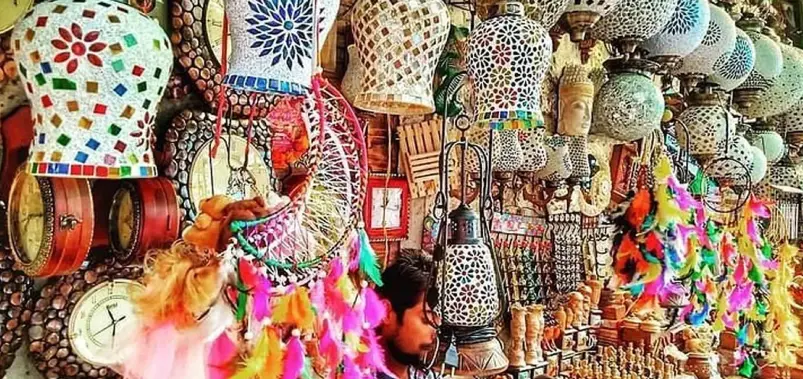
Also worth targeting in April: summer dresses with export tags in European sizing (look for the size label placement inside the collar or waistband — genuine export pieces almost always have the size tab in a specific standardised position that domestic-made imitations frequently get slightly wrong), and lightweight trousers in the ₹150–₹300 price range that, in genuine export quality, would retail for eight to twelve times that in an organised retail context.
The Bargaining Culture: What’s Real and What’s Content
TikTok and Instagram Reels have created a Sarojini Nagar bargaining mythology that is, to put it gently, about 40% accurate.
The mythology says: everything is wildly overpriced at first ask, you must counter at a third of the stated price, dramatic walking-away always works, and vendors secretly want to sell at whatever price you name. This is content logic, not market logic.
Here is what is actually true about bargaining at Sarojini. Most vendors operate on a margin structure that has a genuine floor. The front-section stalls, especially those serving a tourist and influencer crowd, have built in a “first ask” premium that absolutely rewards counter-offering — but the counter should be about 40–50% of first ask, not 30%, and a genuine walk-away works only if you have actually identified the item elsewhere in the market (the vendor can tell the difference between a real walk and a fake one).
The middle and back-section vendors, who move volume, have less premium built into their first ask and correspondingly less appetite for extended negotiation. Asking for a price on multiple items simultaneously (“I’m taking five, what’s the lot price?”) is more effective here than item-by-item haggling.
What the content version gets wrong most dangerously is the tone. The viral Sarojini bargaining videos that show aggressive, dismissive, or theatrically condescending behaviour toward vendors are not savvy — they are rude, and they damage the experience for the buyer and for everyone who comes after. The most effective bargaining at Sarojini has always been friendly, fast, and physically present — looking at the item properly, showing genuine interest, asking the price conversationally, countering with a number, and either closing quickly or moving on without drama.
Vendors at Sarojini are running small businesses on thin margins in a high-competition environment. The ones who have been there for twenty years have seen every bargaining trick that has ever been filmed. Treating the transaction as sport or content is immediately readable and makes you a worse negotiator, not a better one.
The Actually Useful Things to Know Before You Go
The market is most navigable on weekday mornings, specifically Tuesday through Thursday between 10 AM and 1 PM. Weekends are crowded to the point of being operationally difficult — the lanes are narrow, the crowd is thick, and vendors are simultaneously serving too many people to give you their full attention. Monday is a partial shutdown for many stalls (a traditional market holiday pattern in Delhi bazaars). Friday afternoons see restocking happen visibly, which sounds like a reason to go but is actually chaotic and disorganised.
Carry cash. The market runs predominantly on cash, and while a few larger stalls have UPI QR codes, the best-priced vendors in the middle and back sections often prefer cash for negotiated deals. Bring more than you think you’ll spend and in small denominations — asking for change on a ₹500 note when you’ve negotiated a ₹120 purchase is a negotiating setback.
Wear something easy to pull on and off over your clothes. There are no changing rooms, and trying things on happens at the stall, over what you’re already wearing. A fitted t-shirt and leggings or simple trousers make this dramatically easier.
Finally, and this is perhaps the most contrarian piece of advice this article contains: don’t make a list before you go. Sarojini rewards the eye trained to notice quality, not the checklist shopper seeking a specific item. The market’s supply is genuinely stochastic — what’s there on a Tuesday in April will not be there in precisely the same form the following week. Come with a category sensibility (I want linen-weight summer fabrics, I want structured basics in neutral tones) and let the inventory tell you what that looks like today.
The market has been rehabilitated in cultural perception. The actual skill of shopping it well has not changed at all. It still rewards patience, knowledge, a good eye, and the willingness to walk the whole thing once before you buy anything. That hasn’t become content yet. Which means it’s still just advice.