Here is a historical fact that sounds like satire but is completely true. The entity that colonized the Indian subcontinent, extracted wealth estimated by economist Utsa Patnaik at approximately forty-five trillion dollars over two centuries, dismantled functioning industries, rewrote legal systems, and fundamentally altered the trajectory of one of the world’s oldest civilizations was not, technically, a government. It was a company. A joint-stock trading company incorporated in London on the 31st of December 1600 by a royal charter from Queen Elizabeth I, created with the modest initial ambition of importing spices from Asia more cheaply than the Portuguese were managing at the time. The East India Company, which eventually employed its own army larger than Britain’s national military, administered tax collection across hundreds of millions of people, and negotiated with foreign governments as a sovereign entity, started as a commercial venture whose investors were primarily worried about pepper prices. If that does not make you sit up slightly straighter and reconsider everything you thought you understood about how history works, nothing will.
The Origin Story Is Somehow Even More Absurd Than the Headline
Understanding how the East India Company actually began requires understanding the specific commercial frustration that created it. Portuguese traders had established a route to Asia around the Cape of Good Hope at the southern tip of Africa in the late fifteenth century, giving them a monopoly on the spice trade that made pepper, nutmeg, cloves, and cinnamon available in Europe at prices that were, from an English merchant’s perspective, genuinely outrageous. Spices were not a luxury in sixteenth-century Europe. They were food preservation technology, medicine, and status symbol simultaneously, and paying Portuguese middlemen for the privilege of accessing them was a commercial irritation that motivated serious capital investment in finding an alternative. A group of London merchants pooled approximately seventy-two thousand pounds, which was an enormous sum in 1600, received their royal charter, and sent their first fleet of five ships eastward. The initial voyages returned profits significant enough to encourage continued investment, and the company established trading posts called “factories,” which were not manufacturing plants but warehouse and administrative facilities, at ports along the Indian coastline. Surat in 1608 was the first. Madras in 1639. Bombay, gifted to the British Crown as part of a Portuguese royal wedding dowry and promptly leased to the Company for ten pounds of gold per year in what remains one of history’s most consequential real estate transactions, in 1668. Calcutta in 1690. These trading posts were initially exactly what they appeared to be: commercial outposts where the Company bought Indian textiles, spices, and later opium, and sold English woolens that nobody in a tropical climate particularly wanted, which created a persistent trade deficit that the Company addressed through increasingly creative and eventually coercive means.The Pivot from Trading to Ruling and Why Nobody Stopped It
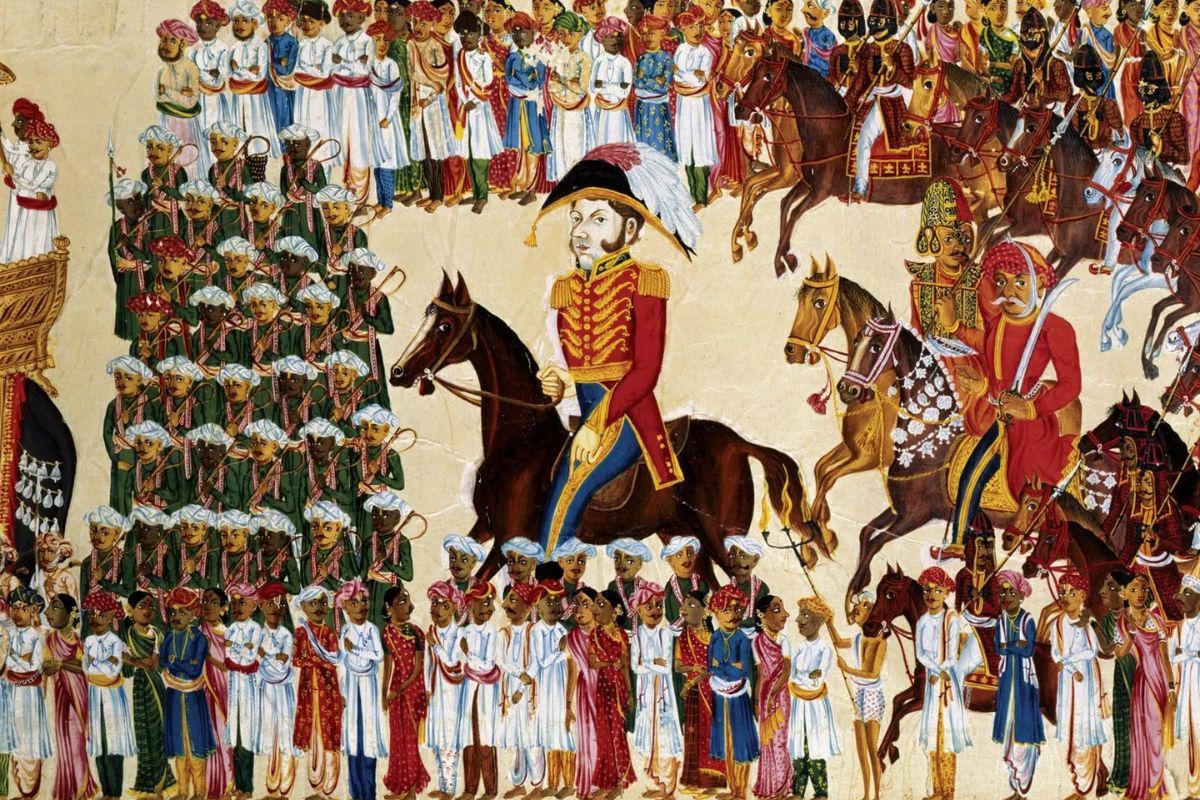
The transition from trading company to territorial power did not happen through a single dramatic decision. It happened through a series of incremental escalations, each of which seemed locally justified at the time and globally consequential only in retrospect, which is how most of history’s largest disasters actually unfold. The Company’s factories needed protection from rival European powers, particularly the French and the Dutch who had their own imperial ambitions in the subcontinent. Protection required soldiers. Soldiers required officers. Officers required hierarchy and discipline and the infrastructure of a military organization. By the mid-eighteenth century, the Company maintained its own army of sepoys, which were Indian soldiers trained and equipped by the Company and commanded by British officers, numbering in the tens of thousands. The Battle of Plassey in 1757 is the moment historians point to as the hinge on which everything turned. Robert Clive, a Company administrator who had reinvented himself as a military commander with a gift for political manipulation that would have made a modern public relations consultant weep with admiration, defeated the Nawab of Bengal Siraj ud-Daulah through a combination of battlefield tactics and having secretly arranged beforehand for the Nawab’s own general Mir Jafar to betray him mid-battle in exchange for being installed as the replacement Nawab. The victory gave the Company effective control over Bengal, which was at the time one of the wealthiest regions on earth, producing fine textiles that sold across Asia and Europe and generating tax revenues that dwarfed what the Company had been earning through trade alone. The Company’s response to this windfall was to extract it as rapidly and comprehensively as possible, which is where the story transitions from morally complicated to genuinely catastrophic. The diwani, meaning the right to collect tax revenue across Bengal, Bihar, and Orissa, was granted to the Company by the Mughal Emperor Shah Alam II in 1765. The Company now controlled territory, collected taxes from millions of people, and maintained an army to enforce its authority, while remaining, technically, a commercial entity answerable to shareholders in London who were primarily interested in dividend payments.What the Company Did With That Power and Why Economic History Matters
The consequences of Company rule over Bengal became visible almost immediately in the form of the Bengal Famine of 1770, which killed somewhere between seven and ten million people, representing approximately one-third of Bengal’s total population. The famine resulted from a combination of drought and the Company’s extraction policies, which had dramatically increased tax demands on agricultural producers even as crop failures reduced their capacity to pay, and which continued demanding tax revenues while people starved because the shareholders in London needed their returns maintained. Edmund Burke, the Irish-British political philosopher, described the Company’s Bengal administration as “a state in the disguise of a merchant” and spent years attempting to have its leadership prosecuted for crimes against the people they governed, with limited success. The systematic deindustrialization of India that followed Company control and later Crown rule is the economic story that contemporary historians have done the most work to document and quantify. India in the early eighteenth century produced approximately twenty-five percent of global GDP, making it one of the two or three largest economies in the world alongside China and comparable in size to the entirety of Europe. Its textile industry was globally dominant, with muslin from Dhaka so fine that it was described by traders as “woven air” and exported to markets across Asia, the Middle East, and Europe. The Company’s response to competing with this industry was to impose prohibitive tariffs on Indian textiles entering Britain while simultaneously using its territorial control to force Indian weavers to sell to the Company at fixed prices below market rates. The combined effect of these policies over decades was the destruction of Indian textile manufacturing and the transfer of that manufacturing to British mills using industrialized production methods. By 1947, when India achieved independence, the country’s share of global GDP had fallen from roughly twenty-five percent to approximately four percent. Whether one attributes that entire decline to colonial extraction, to the structural disadvantages of being a colonial economy rather than an autonomous one, or to global economic shifts that would have affected India regardless, the trajectory from one of the world’s largest economies to a substantially impoverished one over two centuries of Company and Crown rule is one of history’s most consequential economic transformations.The Company’s End and What Replaced It
The Indian Rebellion of 1857, called the Sepoy Mutiny in older British historiography and the First War of Independence in Indian nationalist historiography with both labels reflecting the political commitments of whoever applied them, was the event that finally ended the Company’s direct rule. The rebellion began among sepoys objecting to cartridges for their new Enfield rifles that were rumored to be greased with cow and pig fat, which was offensive to both Hindu and Muslim soldiers, and expanded into a broader uprising across northern and central India involving civilian populations, former rulers displaced by Company annexations, and communities bearing accumulated grievances from decades of Company economic and social policies. The rebellion was suppressed with significant brutality after more than a year of fighting. Its consequence was the Government of India Act of 1858, which abolished the East India Company entirely and transferred its territories, its army, its debts, and its administrative apparatus directly to the British Crown. India became formally a part of the British Empire with Queen Victoria proclaimed Empress of India in 1877. The Company that had begun as a pepper importer and accidentally acquired a subcontinent was dissolved, its assets nationalized by the government that had spent two centuries using it as a commercially deniable instrument of imperial expansion. The shareholders received compensation. The Indian people received continued colonization under new management.Why This History Is Trending in 2026 in Ways That Feel Surprisingly Contemporary
The East India Company’s story has experienced a significant renewal of scholarly and public interest in recent years for reasons that connect directly to contemporary conversations rather than purely antiquarian curiosity. Nick Robins’ book The Corporation That Changed the World, first published in 2006 and continuously reissued since, argues that the Company invented many of the governance failures associated with modern multinational corporations, including the externalization of costs onto governments and populations, the prioritization of shareholder returns over stakeholder welfare, and the use of regulatory capture to prevent accountability. These arguments resonate differently in an era when technology companies wield economic and informational power that rivals or exceeds that of many national governments, making the Company’s story feel less like distant history and more like a template. Shashi Tharoor’s 2016 book Inglorious Empire and his viral Oxford Union speech arguing that Britain owes India reparations for colonial extraction reignited a public debate about colonial economics that continues actively in 2026. The reparations conversation is not merely rhetorical. It connects to live political discussions about foreign aid, debt forgiveness, climate finance, and the moral obligations of wealthy former colonial powers toward nations whose economic trajectories were substantially altered by colonial policies. Understanding the East India Company’s specific mechanisms of extraction, which differed from simple theft in being systematically institutionalized through tax collection, trade policy manipulation, and deindustrialization, is prerequisite knowledge for participating in that conversation with any depth. The Company’s story is also newly relevant to anyone thinking about artificial intelligence, data, and platform power, which is to say everyone in 2026 whether they intend to think about it or not. The pattern of a private entity accumulating informational and operational power that rivals and eventually exceeds state power, using that power to extract value from populations who become dependent on its infrastructure, and resisting accountability through arguments about commercial necessity and innovation is not a new pattern even if the technological substrate is entirely different. Historians who specialize in the Company period have been some of the most interesting voices in contemporary technology regulation debates precisely because they recognize the structural similarities that pure technologists tend not to see.The Lesson That History Is Trying Very Hard to Teach
What the East India Company’s story ultimately demonstrates, with more evidence than almost any other historical episode, is that economic structures are not politically neutral. The way trade is organized, who gets to set the terms of exchange, which industries receive protection and which face competition, and who captures the surplus generated by economic activity are not technical questions with objectively correct answers. They are political questions whose answers reflect the distribution of power among the parties involved, and they have consequences that accumulate over generations into vastly different outcomes for the populations on different sides of those arrangements. India’s contemporary economic story, the one about becoming the world’s third-largest economy and growing at 6.5 percent annually and processing eighteen billion digital payments monthly, is inseparable from this history in ways that matter for interpreting what those numbers mean and where they might go. The economic base from which India is growing was substantially shaped by two centuries of policies designed to serve external interests rather than domestic ones. The deindustrialization was real. The extraction was real. The impoverishment of what had been one of the world’s most sophisticated economies was real. The recovery from that trajectory, which is what the contemporary growth story represents, is therefore more impressive than the raw GDP numbers suggest, because it is not growth from a natural starting point but growth from a historically constructed disadvantage. None of this is an argument for economic victimhood or a claim that colonial history explains everything about contemporary India’s challenges. India’s economic complexity in 2026 reflects domestic political choices, institutional strengths and weaknesses, demographic realities, and global economic dynamics that extend well beyond colonial legacy. But it is an argument that economic history is not optional background knowledge for people trying to understand contemporary economic situations. The balance sheet of the past does not simply reset when political arrangements change. It carries forward in infrastructure that was or was not built, in industries that were or were not developed, in institutions that were shaped by the purposes they were created to serve, and in the cultural and psychological sediment that centuries of specific power relationships deposit in the societies they organize. The East India Company started trying to buy pepper more cheaply. What it built in the process was a two-century lesson in how economic power and political power amplify each other when left without effective accountability. That lesson was taught at enormous cost. The least we can do is study it carefully enough that the learning was not entirely wasted.






 BY admin