



At its peak, the British East India Company governed 90 million Indians with a civil establishment of roughly 3,000 Europeans. The management techniques that made this possible are among the most instructive — and disturbing — case studies in institutional history.
The Size Paradox — How a Trading Company Became an Imperial Power
The East India Company received its royal charter from Elizabeth I on December 31, 1600. It was, at its founding, a fairly ordinary joint-stock trading enterprise — 218 merchants pooling capital to import pepper and calico. Nothing in its Articles of Association suggested that within 150 years it would be maintaining its own army, trying and executing its own judicial sentences, signing treaties with sovereign rulers, and administering a territory larger than Western Europe.
The paradox of scale is the first thing to reckon with. When the Company reached the apogee of its power in the late 18th century, it directly governed Bengal, Bihar, and Orissa — a population of roughly 40 million — with a covenanted civil service of around 1,200 Europeans. By 1830, when its Indian dominions had expanded further, the entire European administrative apparatus remained stubbornly, almost absurdly small. The ratio of ruler to ruled was something like one European civil servant for every 30,000 subjects. Your average mid-sized technology company today employs more people to manage its internal HR processes.
The question of how this was possible is not merely academic. It gets to the heart of how power actually functions — not through the constant exercise of force, which is expensive and exhausting, but through the construction of systems, incentives, and psychological frameworks that make populations govern themselves. The Company did not conquer India with an army of Englishmen. It conquered India with an army of Indians, financed by Indian revenue, fighting wars that served Company interests but were framed as something else entirely.
The transformation from trading company to imperial power happened in stages, each one slightly more brazen than the last. The Company’s original strategy was the factory system — fortified trading posts at Surat, Madras, Bombay, and Calcutta — with purchase and sale as the fundamental transaction. But the commercial logic of trade kept colliding with Indian political instability, and the Company’s response to instability was invariably military.
Each war fought to “protect trade” produced new territories that needed administering, which required more revenue, which required more control. Robert Clive’s victory at Plassey in 1757 — achieved through bribery, betrayal, and a battle that lasted barely three hours — transferred the Diwani rights of Bengal to the Company in 1765. Diwani meant revenue collection. The Company had stopped being a merchant and become a landlord.
The Organizational Structure — Three Interlocking Machines
The genius of the Company’s administration, such as it was, lay in its tripartite structure: a civil service, an army, and a commercial operation, each feeding the others in ways that would make a modern management consultant salivate.
The civil service — “covenanted” employees who had signed formal agreements with the Company — was the smallest and most elite tier. These were the Collectors, Residents, and Commissioners who managed districts, sat at princely courts, and translated Company policy into local reality.
They were typically young men in their late teens recruited through a combination of patronage and, after the founding of Haileybury College in 1806, a standardised education in Indian law, languages, and political economy. Haileybury was, in a very real sense, the world’s first dedicated school of colonial administration. It produced men trained to think of governance as a technical discipline — which it partly is, which made it more dangerous.
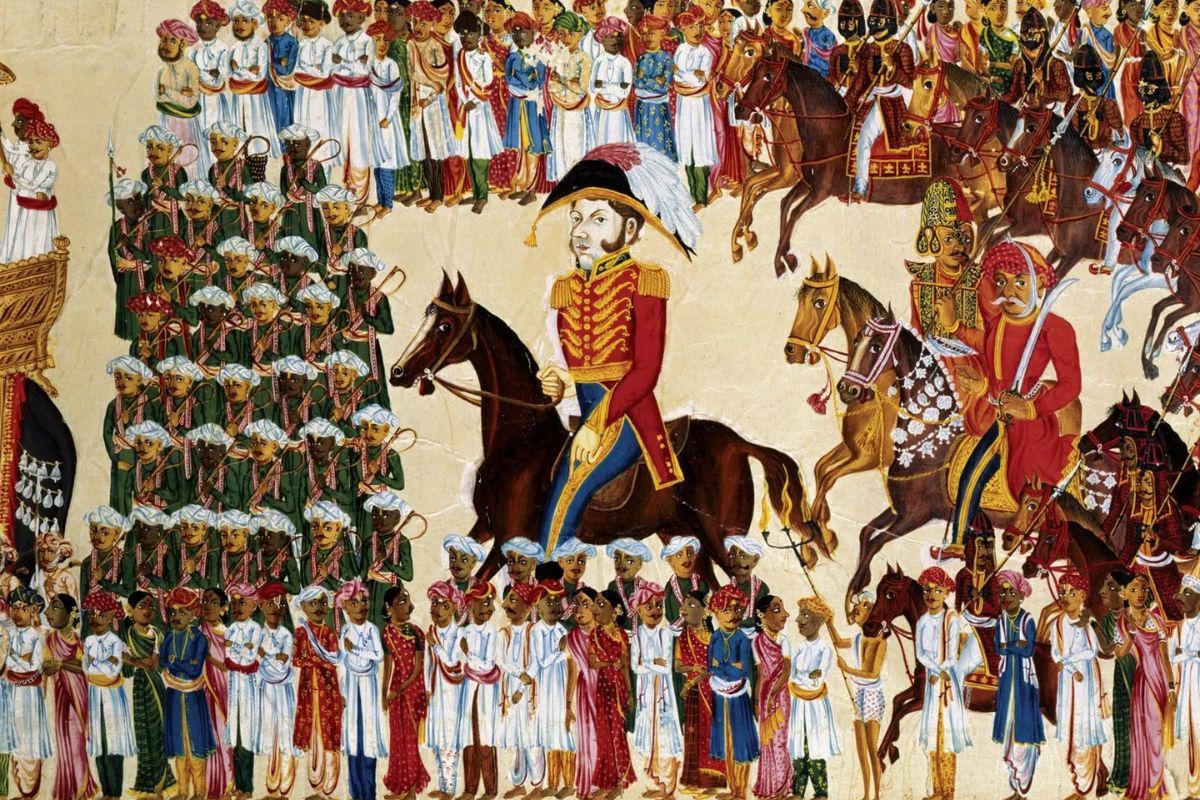
The army was the critical engine, and it was not British. By 1857, the Company’s Bengal Army alone comprised roughly 150,000 Indian sepoys commanded by fewer than 26,000 British officers. The Madras and Bombay armies added another 80,000 Indian soldiers. The Company had, in effect, created one of the largest standing armies in Asia, funded entirely by Indian taxation, staffed almost entirely by Indians, and pointed in whatever direction Company interests required. The genius — and the fundamental instability — of this arrangement was that it depended on the continuous willingness of Indian soldiers to fight for an employer whose ultimate interests were not theirs.
The commercial arm, by the time of the Company’s peak, was almost beside the point — which is itself a revealing fact. The original trading functions had been subordinated to the administrative and military ones. The Company was no longer primarily making money from trade; it was making money from taxation and monopoly. The opium monopoly, which the Company cultivated in Bengal and sold into China via licensed traders, was by the early 19th century one of the most profitable single-commodity operations in the world. This too was administration, not commerce.
Divide and Rule — Documented Practice, Not Slogan
“Divide and rule” is so frequently invoked as a colonial cliché that it has lost its analytical sharpness. This is unfortunate, because as a documented set of specific administrative practices, it is genuinely illuminating.
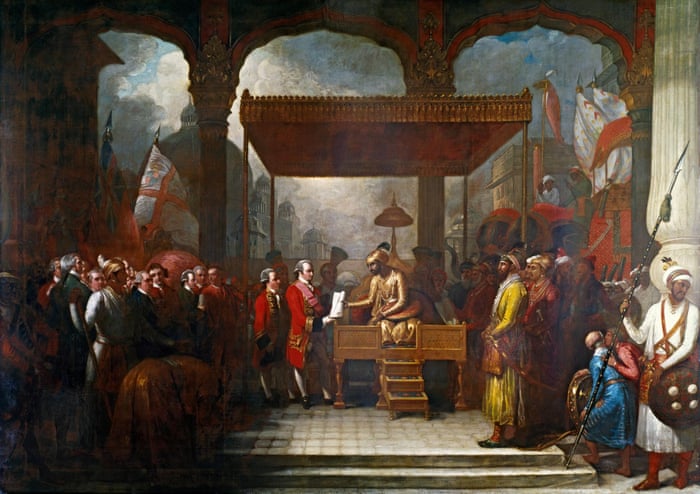
The Company’s approach to Indian political fragmentation was not simply opportunistic — it was systematic. One of its most powerful instruments was the Subsidiary Alliance system, perfected by Richard Wellesley (the Duke of Wellington’s older brother) after 1798. The mechanism was elegant in its brutality: an Indian ruler would enter into a “subsidiary alliance” with the Company, agreeing to host a Company garrison on his territory and pay for it from his own treasury.
In exchange, the Company promised to protect him from external enemies. The consequences were predictable. The cost of the garrison typically exceeded the ruler’s means, generating debt to the Company. The ruler, now militarily dependent and financially indebted, was in practice a vassal. Hyderabad, Awadh, and the Maratha states all entered this trap at different moments. It is worth noting that this was not merely the exploitation of weakness — it was the manufacture of weakness.
Beyond inter-state manipulation, the Company practised a subtler divide-and-rule within communities. The decision about which Indian communities would be recruited into the Army was itself a political act with long-lasting social consequences. The martial races theory — developed most explicitly after 1857 but gestating well before — held that certain communities (Gurkhas, Sikhs, certain Rajput and Punjabi groups) were by nature warlike and reliable, while others (particularly educated Bengalis) were not.
This was pseudo-scientific nonsense, but it was administratively useful pseudo-scientific nonsense. It gave the Company and later the Crown a rationale for constructing an army whose ethnic composition was deliberately calibrated to prevent solidarity. Sikhs would be deployed against Bengali sepoys, Gurkhas against Marathas. The army that protected Company rule was specifically designed to be incapable of united resistance to it.
The revenue settlement system operated on similar logic. The Permanent Settlement of Bengal (1793), devised by Cornwallis, created a new landlord class — the zamindars — by converting formerly fluid revenue-collection rights into heritable private property. This was partly ideological (the Company’s directors were readers of Adam Smith and believers in private property as the basis of improvement) and partly political.
A new propertied class dependent on Company law for the security of its property was a class with a material interest in Company rule. The engineering of collaborators through property rights is a more sophisticated technique than simple bribery, because it aligns long-term interests rather than purchasing short-term compliance.
The Economic Extraction Mechanism — How Bengal Funded Birmingham
The economic history of Company Bengal is not subtle, but it has been persistently obscured by the comforting narrative that trade, however unequal, is mutually beneficial. The numbers tell a different story.
When the Company acquired the Diwani of Bengal in 1765, it gained the right to collect revenue from one of the richest agricultural and manufacturing regions in the world. Bengal’s cotton textiles — muslin so fine it was called “woven air” — were exported globally. Its surplus agriculture fed a vast population and generated taxable wealth. What the Company did with this was straightforward: it used Bengal’s revenue to buy Bengal’s goods, which it then exported to Britain and sold at a profit.
This was what the economist Utsa Patnaik, in her meticulous analysis of colonial trade data, calculated as a net “drain” of somewhere between $45 trillion and $9.2 trillion (in contemporary dollar terms, depending on methodology) transferred from India to Britain across the colonial period. Even the more conservative end of that estimate is staggering.
The drain operated through a mechanism called “Home Charges” — the costs that India was made to pay for its own administration, including the salaries and pensions of British officials paid in Britain, the interest on loans raised in Britain for Indian infrastructure, and the costs of wars fought in India (and sometimes well beyond India) in the Company’s interest.
Indian taxpayers paid for the Afghan Wars, for the suppression of the Opium Wars in China, and for the construction of the railways — which were built on guaranteed returns to British investors funded by Indian taxation.
The famine dimension of this extraction is where the argument becomes hardest to look at steadily. The Bengal famine of 1770 killed an estimated 10 million people — roughly one-third of Bengal’s population — in the years immediately following the Company’s acquisition of revenue rights.
Revenue collection did not pause during the famine. Harvest failure coincided with Company enforcement of its revenue demands, and the combination was catastrophic. The famine is not frequently described as a consequence of economic management decisions, but it is difficult to describe it as anything else.
The Collapse — How the Company Mismanaged Its Own Dissolution
The uprising of 1857 — called the Mutiny by the British, the First War of Independence by later Indian nationalists — was triggered by a specific and almost comic act of administrative carelessness. The new Enfield rifle cartridges issued to sepoys were rumoured to be greased with a combination of beef and pork fat, requiring soldiers to bite the cartridge before loading.
This was offensive to both Hindus and Muslims. Whether the rumour was entirely true is less important than the fact that the Company’s administration had, by 1857, accumulated enough genuine grievances — in the Army, among dispossessed princes, among displaced landlords, among affected communities — that when an ignition point arrived, the tinder was everywhere.
The Company’s mismanagement of the crisis was multi-layered. First, it had consistently underestimated the degree to which the subsidiary alliance system and the doctrine of lapse (by which the Company annexed states where rulers died without “natural” heirs, refusing to recognise adoption) had generated active enemies among India’s ruling classes.
Awadh was annexed in 1856 under this pretext, and its disbanded army provided both the grievance and the military expertise that powered the uprising. Second, the Company’s intelligence systems — which had been genuinely effective in the early 18th century — had atrophied. The warnings were there; they were ignored or misread. Third, the racial arrogance that had grown alongside colonial power had destroyed the quality of communication between British officers and Indian soldiers. The mutual understanding that had made the sepoy army function was gone.
The Crown’s takeover of India in 1858 was not the Company’s redemption. It was the recognition that an institution structured around commercial incentives was an inadequate vehicle for imperial governance. The Company had built an empire; it could not, in the end, maintain one.
The Contemporary Lesson — Institutional Capture and the Illusion of Free Markets
The East India Company is perhaps the most instructive example in history of what political scientists call institutional capture: the process by which a private entity, operating within a legal and political framework, gradually takes control of that framework and reorients it toward private ends. The Company did not begin with the intention of ruling India. It arrived at that destination through a sequence of commercially rational decisions that were, individually, defensible, and collectively, catastrophic.
The lesson for thinking about contemporary institutions is not that corporations are evil. It is that structures without accountability generate extraction, and that “free markets” have never actually existed in the form their advocates describe. The Company operated under a royal charter, benefited from Royal Navy protection, had its wars funded by the British state when its own resources were insufficient, and faced genuine consequences for shareholder value but almost none for human consequences. It was a public-private hybrid from the beginning, and its destructiveness was inseparable from that hybridity — the privatisation of profit and the socialisation of cost.
The Haileybury model — training technocrats to think of governance as administration rather than politics — has had extraordinary staying power. The idea that the management of populations can be separated from the question of whose interests are being served is an idea the Company refined and exported, and it remains alive in every institution that hires brilliant, well-trained people to optimise systems whose foundational purpose goes unexamined.
The Company conquered India with fewer people than your office building. The more uncomfortable question is: with what tools, and in whose service, are institutions of comparable power operating today? The apparatus has changed. The logic of the subsidiary alliance — indebtedness as dependency, dependency as control — is not difficult to find in contemporary international financial architecture. The martial races theory — the calibrated construction of workforce identities that prevent solidarity — is not absent from contemporary human resources practice.
History does not repeat. But institutions, once they learn a technique that works, are very reluctant to forget it.
The East India Company was dissolved in 1874. Its archive, held at the British Library, runs to several miles of shelving. The full accounting of what it set in motion has not yet been completed.