



Okay fam, if you missed what just went down at Livigno Snow Park on Sunday night, you literally missed one of the most insane moments in winter sports history. We’re talking absolute chaos, mind-blowing tricks, and a level of skiing that has the entire freeski community losing their collective minds. The men’s freeski big air qualification round at the Milano Cortina 2026 Olympics was basically the equivalent of watching twelve dudes say “hold my Red Bull” and proceed to rewrite what’s physically possible on skis.
Mac Forehand Said “I Learned This Three Days Ago” and Absolutely Sent It
American Mac Forehand topped the qualification round with a score of 183.00, combining a switch left triple cork 1980 that earned him 93.25 points with a left nose-butter triple cork 1620 that scored 89.75. But here’s where it gets absolutely bonkers: Forehand casually mentioned after his run that he learned one of these tricks literally three or four days ago. Like, imagine learning to do something that involves spinning your body 1,620 degrees while flipping multiple times in the air, and then just throwing it down at the Olympics a few days later like it’s nothing. That’s big main character energy right there.
The X Games champion looked completely in his element under the floodlights, basically treating the Olympic qualifiers like his personal playground. He’s now sitting pretty in first place heading into Tuesday’s final, which means he gets to drop in last and watch everyone else’s runs before deciding how hard to go. Strategic king behavior, honestly.
Norway’s Birk Ruud is Built Different
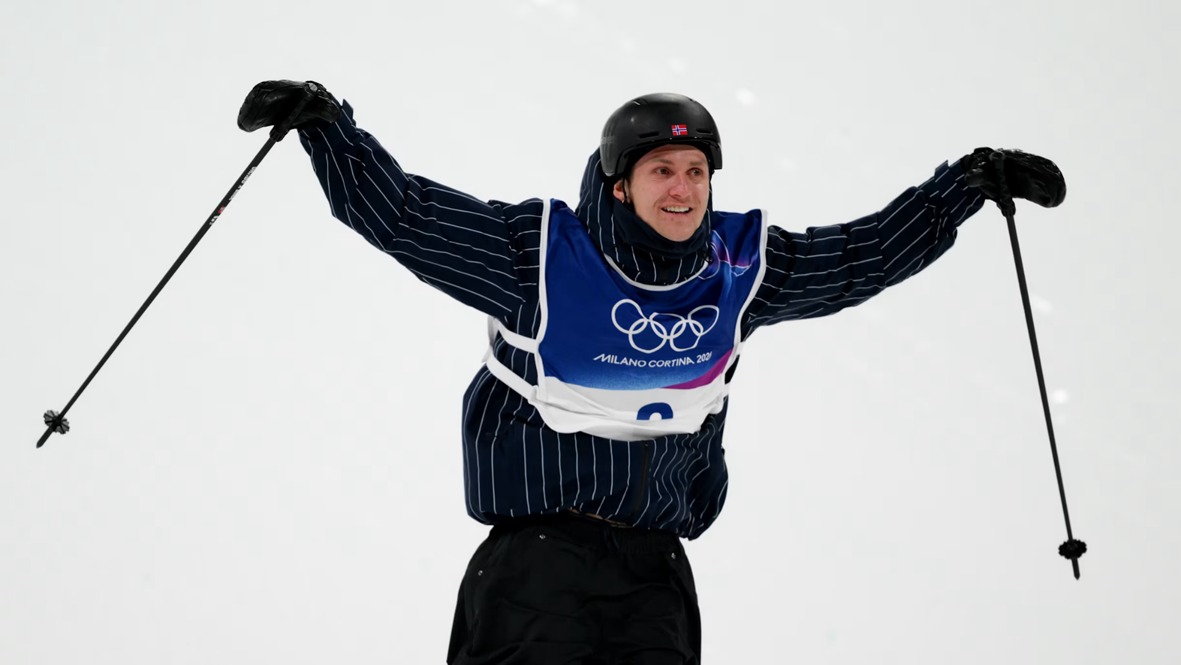
Speaking of absolute legends, can we talk about Birk Ruud for a second? This Norwegian superstar already won gold in slopestyle at these same Olympics last week, and instead of taking a breather, he casually cruised into third place in big air qualifications with 181.00 points. The defending Olympic champion from Beijing 2022 was so confident that he didn’t even bother with his third qualifying run. He literally said “two runs is enough” and dipped, while everyone else was out here sweating. The man even celebrated his first run by doing a forward flip in the finish area because apparently, regular skiing isn’t enough excitement for him.
Ruud has been open about using mental techniques and even taking up professional snowboarding to help him rediscover his passion for freeskiing. Whatever he’s doing, it’s working, because he’s out here collecting Olympic golds like they’re Pokemon cards. The way he described needing “contest pressure to reset” shows this dude literally thrives when the stakes are highest. Built different, no cap.
The Vibes Were Immaculate (Until They Weren’t for Some)
Austria’s Matej Svancer, who won gold at the 2020 Youth Olympics, secured second place with 182.25 points, proving that the young guns are absolutely here to compete. Norway’s Tormod Frostad put up the single highest trick score of the entire night with a mind-melting 96.25 for his right nose butter double bio 1440, landing him in fourth place overall with 180.25.
New Zealand’s Luca Harrington, the reigning world champion, locked in fifth place with 179.75 and basically summed up the whole vibe: “It’s been a crazy event. The tricks that have been put down are spectacular. These are massive, massive tricks.” Like, when the actual world champion is geeking out over what everyone else is doing, you know the level is unreal.
The Plot Twists Hit Different
But not everyone had a fairytale night. In what can only be described as absolutely devastating, slopestyle silver medalist Alex Hall needed a massive score on his third run to qualify but over-rotated and fell. Switzerland’s 2021 world champion Andri Ragettli crashed on his first two runs and was eliminated early. Local hero Miro Tabanelli from Italy absolutely stomped his first run with 91.00 points, had the crowd going absolutely feral, but then couldn’t land his next two jumps. The heartbreak was real, and you could feel it through the screen.
American skiers Troy Podmilsak and Konnor Ralph barely squeaked into the twelve-skier final cut in tenth and twelfth place respectively, despite putting down combinations that would have been podium-worthy at most other competitions. That’s how stacked this field is right now. Podmilsak, who’s had what he called “the worst season of my life” this year, is somehow still here fighting for it at the Olympics. That’s the kind of redemption arc we love to see.
French Skiers Came Out of Literally Nowhere
Can we also give some love to France’s Matias Roche and Timothé Sivignon, who seemingly appeared out of thin air to grab sixth and seventh place? Roche scored 178.50 and Sivignon got 178.00, with Sivignon having only made a World Cup podium twice before this. They really said “surprise, we’re here too” and put the entire freeski world on notice. The depth of talent at this event is genuinely terrifying.
The Numbers Don’t Lie: This Was Historic
Let’s get into the stats that prove this was an all-timer. Eleven skiers received at least one individual jump score of 90 points or higher. That’s not normal. That’s never been normal. In most big air competitions, getting into the 90s on a single trick is a huge deal. Here, eleven different athletes did it. Both Svancer and Ruud had two 90-plus scores each. The judges literally had their work cut out for them trying to differentiate between tricks that were all absolutely insane.
What makes this even more wild is that this was just the qualification round. Everyone was holding back their biggest tricks for the final. Mac Forehand straight-up said he has another trick he learned recently, a nose butter triple cork 1980, that he’s saving for Tuesday. If the qualifiers were this good, the final is about to be absolutely unhinged. Forehand himself predicted it: “It’s going to be one of the best finals ever on skis. If it’s good weather like this, it’ll be insane. People have been skiing so good.”
What This Means for Tuesday’s Final
The final goes down on Tuesday, February 17, at 6:30 PM local time at Livigno Snow Park, and honestly, it might break the internet. You’ve got Mac Forehand sitting in pole position with tricks he learned last week. You’ve got Birk Ruud going for his second gold medal of these Olympics. You’ve got hungry young athletes like Matej Svancer trying to get their first Olympic medal. You’ve got world champion Luca Harrington looking to add Olympic gold to his collection. You’ve got American underdogs trying to prove themselves. And you’ve got the entire field bringing tricks that most people can’t even comprehend.
The format for the final is simple: each skier gets three runs, and their best two scores count toward their total. But nothing about what’s about to happen will be simple. These athletes have been pushing each other all season, and now they’re all in one place with the biggest prize in skiing on the line. The progression we’ve seen in freeski big air over the last few years has been exponential, but what we witnessed in qualifications suggests we’re about to see another quantum leap.
The level of technicality, amplitude, and style on display has commentators and athletes alike struggling to find words. Triple corks with multiple variations, nose butters adding extra complexity, switch takeoffs making everything harder, and rotations that sound like WiFi passwords (1620, 1980, 1440) are all being thrown with consistency that would have been unthinkable even a few years ago.
Why This Matters Beyond Just Cool Tricks
What’s happening at Milano Cortina 2026 represents more than just athletic achievement. It’s the culmination of years of progression in action sports, where athletes continuously push boundaries and redefine what’s possible. The fact that tricks being attempted in qualifications would have won competitions outright just a few years ago shows how rapidly the sport is evolving.
For younger athletes watching around the world, this is inspiration. It’s proof that with dedication, creativity, and a willingness to push limits, you can achieve things that seem impossible. The accessibility of freeskiing compared to some other Olympic sports means kids watching this can actually try to follow in these athletes’ footsteps, making the impact even more significant.
The Bottom Line
Sunday’s qualification round was basically a master class in how to make jaws drop and hearts race. Tuesday’s final is shaping up to be potentially the greatest freeski big air competition ever witnessed. If you care about winter sports, action sports, or just watching humans do absolutely superhuman things, you need to tune in. Set your alarms, clear your schedule, tell your group chat, because this is about to be historic.
The men’s freeski big air final at the 2026 Winter Olympics isn’t just another event. It’s a cultural moment, a demonstration of human potential, and quite possibly the sickest skiing we’ll see this decade. Don’t sleep on it, because you’ll regret it forever if you do. These twelve athletes are about to give us something we’ll be talking about for years.
Stay tuned, stay hyped, and get ready for Tuesday night to absolutely melt your brain. It’s about to get real.