



Hey Indians, you noticed it, didn’t you? That laptop you’ve been quietly watching on a wishlist, refreshing every few days hoping for a sale? It didn’t go on sale. It went up. That smartwatch your friend bought in January is now listed at a price that makes you question your life choices. The D2C electronics brand you’ve been following on Instagram quietly revised its product page last week, and the number at the bottom is not the number you remember.
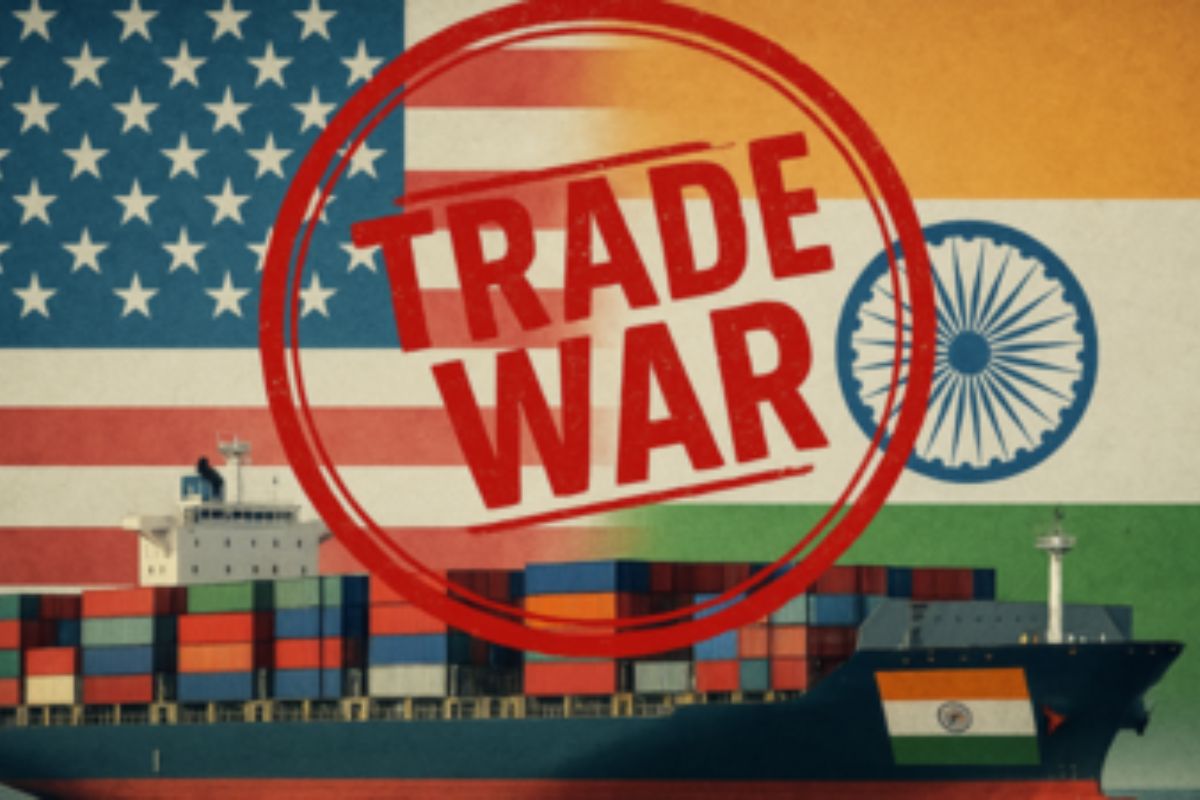
This is not a coincidence. This is a trade war — the most consequential reshuffling of global commerce since the United States passed the Smoot-Hawley Tariff Act in 1930 and accidentally helped turbocharge the Great Depression. And while India is not the primary target this time, it has been sitting squarely in the blast radius for nearly a year. Understanding what happened, what it means for you, and where this goes next is no longer optional. This is the economy that your 30s will be built inside.
What Is Actually Happening, That Will Affect India?
Let’s start from the beginning, because the media coverage has been impressively good at generating heat and light in roughly equal, unhelpful proportions.
A tariff is simply a tax on imported goods. When Country A imposes tariffs on Country B’s exports, it makes those goods more expensive for consumers in Country A, which theoretically protects Country A’s domestic manufacturers from competition. The political logic is simple: voters like the idea of protecting local jobs. The economic reality is messier: tariffs raise prices for consumers, invite retaliation from trading partners, and tend to scramble the global supply chains that nobody fully understands until they break.
The US had long criticised India’s high import duties — India averaged 37% on agricultural products and over 100% on some automobiles. When Donald Trump returned to the White House and began his second administration’s trade offensive in 2025, India was placed on a list of countries facing reciprocal tariffs — a policy that essentially said: whatever you charge us, we’ll charge you back. By August 2025, following months of escalation, the total tariff burden on many Indian imports into the US had been pushed as high as 50%, making it among the most punitive tariff actions Washington had taken against India.
To put that number in perspective: imagine everything India sells to America — textiles, pharmaceuticals, gems, software services, seafood, auto components — suddenly becoming 50% more expensive at the American border overnight. That’s not a headwind. That’s a wall.
The Trump tariffs, taken in aggregate, represent the largest US tax increase as a percentage of GDP since 1993 and amount to an average tax increase per American household of $1,500 in 2026. America, in other words, is also paying for this fight. It just hasn’t fully noticed yet.

The situation has shifted somewhat since the worst of 2025. On February 2, 2026, President Trump announced that the United States had reached an agreement with India to roll back tariffs on Indian imports from 50% to 18%. In exchange, India agreed to move toward zero tariffs on US goods, committed to halting purchases of Russian crude oil, and pledged major future purchases of US products — energy, technology, agricultural goods — with a stated target exceeding $500 billion.
That sounds like a resolution. It is not quite that. Technically, there was never a fully formalised deal. Trump announced it on social media, but India did not respond for several days. When the White House issued a fact sheet, it included references to Indian concessions on pulses — dried legumes — that India said were never agreed. By February 11, the language had already been revised.
What exists, as of today, is a joint framework — a handshake that both sides are trying to turn into an actual agreement — while the broader machinery of global trade remains turbulent. On March 11, 2026, the US Trade Representative initiated new Section 301 investigations into manufacturing excess capacity, naming India alongside China, the EU, Vietnam, Indonesia, and several other countries — investigations that could pave the way to impose new tariffs.
So the trade war is not over. It has entered a more complicated phase where the rules are being negotiated in real time, and the outcomes are genuinely uncertain.
The Indian Angle That Nobody Is Explaining Clearly
Here’s the thing about India in this story: it is simultaneously a victim, a beneficiary, and a participant — often all at once.
The victim part is easier to see. When the initial tariffs were at their peak, Indian MP Shashi Tharoor noted that 135,000 people in the city of Surat — the heart of India’s gems and jewellery industry — had been laid off, with the seafood and manufacturing sectors also facing significant job losses. Textiles from Tamil Nadu and Gujarat, carpets from UP, auto components from the Pune-Chennai corridor — all of these faced severe margin compression when the 50% tariff wall went up. The people who lost work were not executives in glass offices. They were artisans, factory floor workers, and small exporters who had spent years building relationships with American buyers.
The steel manufacturing sector was among the hardest hit, with one Mumbai-based producer telling Al Jazeera that his sales to the US and Mexico had been halved since the tariffs came into effect. And Mexico compounded the damage — on January 1, 2026, Mexico implemented steep import tariffs ranging from 5% to 50% on more than 1,400 products from non-free trade nations, including India, creating a double blow for exporters who had been trying to diversify away from the American market.
Now for the beneficiary part, which is the more interesting story. China faces tariffs from the United States that make India’s 18% look positively friendly — the US-China trade war has effectively made China the most expensive place in the world to manufacture goods for the American market. That creates a vacuum. And India, with its large and relatively young labour force, its improving infrastructure, and its existing manufacturing base, is the most logical alternative destination for companies that want out of China.
Analysts have noted that the February framework could restore India’s position as a preferred manufacturing destination, especially for firms seeking to diversify away from China, with sectors like pharmaceuticals, auto parts, chemicals, and electronics expected to see faster order inflows. Apple has been moving a meaningful share of iPhone assembly to Tamil Nadu for a couple of years now. The tariff environment accelerates that logic dramatically. When a company has to choose between manufacturing in China at crippling tariff rates or manufacturing in India at 18%, the spreadsheet starts telling a very different story.
Sectors expected to benefit from the new framework include engineering goods, electronics, textiles, gems and jewellery, pharmaceuticals, and MSME-driven handicrafts — if the final agreement actually holds and the BTA negotiations don’t collapse under the weight of disagreements about agriculture and digital services. That is a meaningful if.
India also exports something the tariff conversation tends to ignore entirely: software services. IT exports to the United States run to tens of billions of dollars annually and are largely exempt from the tariff framework, because you cannot slap an import duty on a line of code. This gives India a built-in buffer that manufacturing-heavy economies like Bangladesh and Vietnam simply do not have.
The Delhi Consumer Reality
Let’s bring this home. Literally.
The most direct way the trade war touches your daily life in Delhi is through electronics pricing. Most consumer electronics — phones, laptops, tablets, peripherals — involve global supply chains that touch China heavily, even when the final assembly happens in India or elsewhere. Component costs have risen. Shipping logistics have been disrupted. Brands pass those costs on to consumers, rarely with a press release explaining why. That quiet price increase on the laptop you were watching? That is the supply chain repricing itself in real time.
Imported goods at premium retail — the international skincare brands at Select City Walk, the imported wines at a restaurant in Hauz Khas, the European appliances at premium electronics stores — will all face pressure as the rupee navigates a more volatile dollar relationship. The rupee has historically weakened when global trade uncertainty rises, because investors move toward the dollar as a safe haven. A weaker rupee means imported goods get more expensive in rupee terms even if their dollar price stays flat.
If you are planning an international trip and booking in dollars — flights, hotels, experiences — a stronger dollar means your holiday just got quietly more expensive. This is not a hypothetical. Check your travel budget from two years ago and compare it to what the same trip costs today.
Startups that import components for hardware products, or that have significant dollar-denominated costs, are navigating real pain. If you work at a Delhi or Gurugram hardware startup, you will have heard conversations in the last year about pricing pressure, margin compression, and the very unpleasant maths of selling in rupees while buying in dollars. Several early-stage companies that were building products with imported components have either pivoted or slowed down launches precisely because the cost base became unpredictable.
The silver lining for the Delhiite with a career lens: a world in which India becomes more attractive as a manufacturing and technology services hub is a world with more high-quality jobs. The ‘China plus one’ manufacturing thesis, if it plays out, creates employment in the supply chain ecosystem — from factory management and quality control to logistics, compliance, and finance. That kind of economic broadening reaches Delhi’s professional ecosystem eventually, even if it starts in Pune or Chennai.
What Happens Next
Two plausible futures, and this is genuinely where the uncertainty sits.
In the first scenario, the interim framework gets converted into a proper Bilateral Trade Agreement over the next 12 to 18 months. India makes real concessions on agriculture — accepting some American almonds, apples, and soybean oil at reduced tariffs, accepting the political heat that comes with that domestically — and in exchange, the 18% rate comes down further, possibly into single digits. India’s electronics and textile exporters rebuild their American order books. Foreign direct investment in Indian manufacturing accelerates. The ‘China plus one’ thesis becomes real at scale. India’s GDP growth holds in the 6.5–7% range, the rupee stabilises, and the trade war ends up being a painful but ultimately transformative episode for India’s industrial development.
In the second scenario, the BTA negotiations stall on agriculture and digital services (two areas where India’s domestic political constraints are enormous), new Section 301 investigations lead to fresh tariff pressure, and the geopolitical relationship between the US and India remains complicated by the lingering questions about Russian oil, the India-Pakistan dynamic, and India’s non-alignment instincts. In this scenario, the 18% rate holds but doesn’t improve, global supply chain uncertainty persists, and inflation in India gets a slow upward push from higher import costs, a weaker rupee, and rising energy prices. GDP growth edges down. The startup ecosystem remains cautious on capital deployment.
The honest answer is that both scenarios contain true elements right now. The deal framework exists but is not finalised. The manufacturing opportunity is real but not yet captured at scale. The risk is real but not yet catastrophic. India is, in the technical sense, in play — and that is simultaneously the most anxious and the most interesting place for a country to be.
The Line That Matters
Here is the thing about economic inflection points: nobody hands you a notice that says “important historical moment happening, please pay attention.” You only recognise them later, when you’re explaining to someone younger why things are the way they are.
India’s trade relationship with the world’s largest economy is being rewritten right now, in April 2026, in negotiations happening in Washington and New Delhi that will determine which industries grow, which shrink, how many jobs exist in manufacturing versus services, and what things cost at the mall and on your screen.
The 18-to-35 generation will live inside the economy that these decisions create for the next three to four decades. The people currently in their mid-twenties in Delhi will be in their fifties before the full consequences of this period are settled and understood. That is not cause for anxiety. It is, however, cause for paying attention — and for understanding that the price increase on your wishlist is not random. It is a data point in a much larger story that very much includes you.