


Let’s be honest with each other. Most of the people heading to Arun Jaitley Stadium this April do not know the difference between a doosra and a googly, have not checked Delhi Capitals’ NRR once, and could not name a single DC bowler if you offered them free tickets. And yet they will show up, in blue and navy and gold, absolutely electric, three hours before the toss.
They will stand in queues for overpriced loaded fries. They will hold up signs for Instagram and accidentally start a Mexican wave and scream their lungs out when Axar Patel walks to the crease — not because they follow his batting average, but because the entire stadium is screaming and the energy is genuinely, viscerally contagious.
This is not a criticism. It is, in fact, the whole point. The Indian Premier League has long outgrown the sport that spawned it. In April 2026, with Delhi Capitals playing home matches on April 25 against Punjab Kings and April 27 against Royal Challengers Bengaluru — both at Feroz Shah Kotla — the capital city is not gearing up for a cricket tournament. It is gearing up for the cultural event of the season. And if you are still treating it only as a cricket tournament, you are missing the better story entirely.
Section 1: The Match-Day Experience Is a Whole Lifestyle Event
Arrive at Arun Jaitley Stadium on any DC home-game evening and what you encounter, before you even reach your seat, is a masterclass in urban Indian festivity. The gates on Bahadur Shah Zafar Marg start filling from around 5:30 PM, a full two hours before the 7:30 PM start for evening fixtures.
Gate 2 and Gate 8 are the most accessible entry points for those coming from the metro — Pragati Maidan and the ITO metro stations are both a walkable distance, and on match nights, auto-rickshaws cluster outside both exits with almost preternatural efficiency. Driving in and parking is possible, but the surrounding lanes near ITO can back up well before the toss; arriving by metro or cab is, without question, the smarter call.
The fashion, it must be said, has developed its own logic. The DC jersey — navy blue and red, with the teal chevron — is the safe and sensible choice, and thousands wear it. But the genuinely fashion-forward Delhi fan has started to treat match day as a capsule styling exercise. Oversized vintage cricket tees tucked into wide-leg trousers. Blue co-ord sets that technically qualify as team colours. Hand-painted caps. Chunky sneakers — often white, which somehow always seems to survive the stadium. This is a crowd that understands the assignment: show up, look intentional, be ready for photographs at every corner.
Inside the stadium, the food options have expanded significantly in recent seasons. The official stalls within the ground offer the expected — samosas, chaat, club sandwiches, cold beverages — but the queue strategy matters. The stalls toward the North Stand and the Club House end move faster. The best food, in the collective wisdom of the regular Kotla-goer, is the pav bhaji and the paneer tikka wraps from the covered concession area near Block H. Get there in the first ten overs and you will avoid the worst of the rush. By the time the middle overs roll around and the match enters a quiet phase, everyone simultaneously remembers they are hungry, and the queues double. Timing is everything.
The vantage point question also has a real answer. The lower tier, blocks C through F, puts you close to the pitch and within earshot of the players. The upper tier along the Members’ Stand gives you the full aerial view that television cannot replicate. For the social media content creator — and there are many — the upper tier also gives you that sweeping stadium shot with the Delhi skyline at dusk, which has become the season’s defining Instagram frame.
Section 2: The After-Party Circuit — Where Delhi Goes When the Last Ball Is Bowled
The match ends somewhere around 11 PM, and Delhi’s nightlife industry has spent the last several years figuring out what to do with that. The answer, increasingly, is everything.
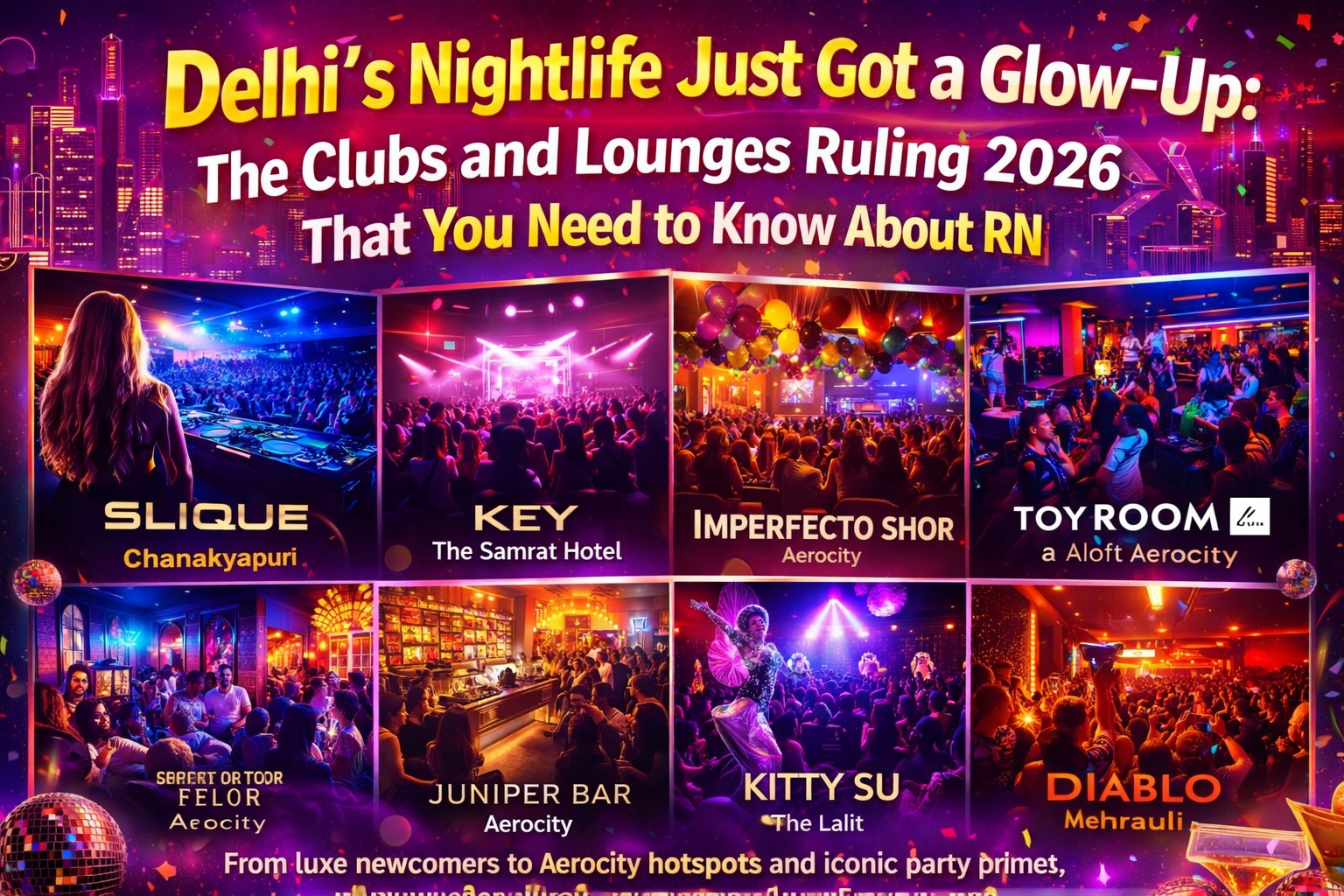
Connaught Place remains the default post-match circuit, partly by virtue of its proximity to the stadium and partly because it has the density of venues to absorb large, energised crowds. Kitty Su at The Lalit — a perennial favourite — has been running themed IPL nights through April, leaning into the cricket aesthetic with cocktail menus named after deliveries and playlists timed to match-day moods. The Lalit’s rooftop bar fills quickly after home wins and fills even quicker after a loss, because Delhi has always known how to either celebrate or commiserate with equal conviction.
In South Delhi, the energy has a slightly different register — more curated, more playlist-aware, less chaotic. The Panchshila Rendezvous in Panchshila Park, Malviya Nagar, is one of the city’s better calls this season: a craft brewery that has committed to the full IPL screening experience, with large-format screens, match-night deals running across April through May 31, and a tap list that makes the waiting-for-the-next-wicket phase genuinely enjoyable. The kind of place where you might actually end up watching more cricket than you planned to, which is either a success or a failure depending on your intentions.
Hauz Khas Village, which has spent the better part of the last decade reinventing itself, has a cluster of rooftop venues that come alive on match evenings — the combination of a cool April night, a phone showing the live score, and a view of the lake is the kind of experience that generates content almost by accident.
The newer Dwarka corridor, often overlooked in city guides that have not kept up with Delhi’s westward expansion, has quietly become a serious nightlife destination. Several multi-level lounges near Sector 10 and Sector 12 have capitalised on the large resident population and its appetite for themed evenings. IPL watch parties here tend to be more neighbourhood in character — less scene-y, more genuinely communal — but with production values that would not embarrass CP.
The one thread connecting all of these post-match venues is the group dynamics. IPL after-parties, more than most going-out occasions, attract mixed groups: the school friends who only meet three times a year, the office groups who needed a reason, the couples who couldn’t get tickets but wanted the atmosphere. The tournament has, among its many less-documented effects, become one of the city’s most reliable social catalysts.
Section 3: IPL as a Content Goldmine — Delhi’s Digital Fans Are Running a Parallel Tournament Online
The match inside the stadium is, by some measures, less interesting than the match happening simultaneously on X (formerly Twitter), Instagram, and fantasy league apps. Delhi’s digitally native fan base has turned IPL season into a content economy of its own.
Fantasy cricket — Dream11, My11Circle, and a half-dozen smaller platforms — has transformed the relationship between fan and match. The casual viewer who did not previously care about individual player performance now watches a middle-order batter’s strike rate with the intensity of a portfolio manager watching interest rates. Fantasy points have created millions of micro-narratives running alongside the main broadcast, and the Delhi fan community has been particularly active in this space. WhatsApp groups dedicated to fantasy league strategy operate with a seriousness that would seem excessive until you realise the amounts of money involved.
The meme economy runs parallel and equally fast. Within minutes of any wicket, dropped catch, or controversial umpiring decision, X is flooded with takes — the format encourages the hot take, the rapid-fire comparison, the brutal callback to a player’s previous failure. Delhi-based creators and accounts have built significant followings precisely by being first and funniest in these moments. The IPL meme is now a genre with its own conventions: the zoomed-in face of a frustrated player, the surprised reaction cut, the historical stat delivered as a punchline.
Instagram has its own grammar for IPL. Stadium reels — the panoramic crowd shot, the slow-motion boundary, the team anthem sung in unison — have become a reliable format that generates saves and shares regardless of the poster’s usual content category. Influencers who ordinarily cover food or fashion or fitness pivot to cricket content for six weeks with almost no apparent friction, because the audience is already there and already engaged.
The conversation does not pause between matches either. Post-game analysis, captain’s press conference hot takes, injury updates, and trade speculation fill the days between fixtures. For many Delhi fans, the social media engagement around IPL has become as compelling as the cricket itself — the tournament as a narrative that you follow across multiple platforms simultaneously, each offering a different lens on the same event.
Section 4: What IPL Season Actually Does to Delhi’s Economy
The numbers behind what IPL does to a host city’s economy are not trivial. A recent Kotak Mutual Fund research report pegged the IPL’s current valuation at approximately USD 18 billion, placing it among the most commercially significant sporting leagues in the world. Hotel occupancy in host cities regularly exceeds 90% during the IPL season, generating substantial hospitality revenue, and Delhi, as a city hosting seven home matches spread from April through May, sees this effect compounded across multiple weekends.
The IPL season typically sees a 10 to 25 percent surge in consumption across urban India, and in Delhi that surge is visible in specific, granular ways. Delivery app orders — Swiggy, Zomato, Blinkit — spike sharply during match windows, particularly in the 5 PM to 9 PM slot on match days. Restaurants that have never marketed around cricket suddenly run IPL-themed combo offers. Local vendors outside the stadium — the ones selling flags, painted faces, light-up wristbands, and six-rupee chai — do the kind of business in one evening that would otherwise take a fortnight.
For the hospitality sector specifically, the match-day footfall creates a multiplier effect beyond the stadium itself. Hotels near ITO and CP fill rooms on match nights with out-of-town fans, business travellers who timed their Delhi trip around a fixture, and families making a weekend of it. The Employment Survey estimates over 20,000 seasonal jobs are generated annually by the IPL across media, logistics, hospitality, and operations — and in a city the size of Delhi, those jobs are distributed across a wide economic geography, from five-star banquet halls to the chai stall on Mathura Road.
Your IPL Weekend Guide for Delhi, April–May 2026
Here is the practical framework for making the most of an IPL weekend in the capital, whether you have tickets or not.
If you have tickets to the April 25 (DC vs Punjab Kings) or April 27 (DC vs RCB) matches, take the metro — Pragati Maidan or ITO stations — and arrive by 6 PM. Wear your best version of blue (navy, teal, royal — all acceptable), bring ID for entry, and eat before you go in or plan to queue strategically around overs 6 to 9 when the food rush is lightest. For the optimal photo, head to the upper tier before sunset.
If you do not have tickets, the Panchshila Rendezvous in Malviya Nagar has live screenings on every match day through May, with craft beer deals that make the cover charge irrelevant. For the CP experience, Kitty Su and the Lalit’s bar floor are the move, but book a table — these venues fill fast after home wins and faster after surprises. For something lower-key and more neighbourhood, the Dwarka Sector 10 corridor has options that will not require a reservation or a taxi through central Delhi traffic.
Regardless of whether you attend or stream, get on X during the match. The second-screen experience is, genuinely, half the entertainment. If you play fantasy cricket, set your team by Thursday afternoon — DC’s spin-friendly pitch at Kotla historically rewards slower bowlers, and Axar Patel in his home conditions is the kind of differential pick that wins leagues.
And if someone asks you whether you went “for the cricket,” feel free to say yes. The cricket is, after all, genuinely good this year. But you were also there for everything else — the lights, the noise, the crowd, the content, the city doing what it does when it has a collective reason to show up. That is not a lesser version of the IPL experience. In April 2026, it might just be the truest one.