



Delhi has been razed and rebuilt at least seven times. The ruins of those cities are under your feet right now. Archaeologists have recently found something extraordinary.
The Seven Cities — And the Cities We Forgot to Count
The “seven cities of Delhi” is one of those historical phrases so often repeated that it has lost its power to astonish. It shouldn’t have. What it describes is a civilisational palimpsest — a single piece of geography that has been written upon, erased, and rewritten again and again across a span of nearly a thousand years of recorded history, and several thousand more before that.
The canonical seven are Lal Kot (founded c. 1060 CE by the Tomar Rajputs), Siri (1303, Alauddin Khalji), Tughlaqabad (1321, Ghiyasuddin Tughlaq), Jahanpanah (1326, Muhammad bin Tughlaq), Firozabad (1354, Firoz Shah Tughlaq), Dinpanah/Shergarh (1533, Humayun; captured and renamed by Sher Shah Suri), and Shahjahanabad (1648, Shah Jahan). Some historians count eight or even eleven if you include substations like Adilabad, Mubarakabad, and the British-laid New Delhi.
What no list adequately conveys is that these were not merely sequential capitals. They were, for the most part, built on top of each other, beside each other, cannibalising each other’s stone. Firoz Shah Tughlaq, a compulsive builder and an equally compulsive dismantler, physically transported an Ashokan pillar from Topra in Haryana and installed it on his ridge as a kind of trophy. The stone of Tughlaqabad was plundered to build Siri. Shahjahanabad grew partly over the bones of Dinpanah. Delhi did not just have a history — it ate its history and built another one.
Beneath those seven, however, lies something older. Excavations and geological surveys have confirmed Painted Grey Ware pottery at Purana Qila, dating the site’s habitation to roughly 1000 BCE — placing it squarely in the late Vedic period and making plausible the long-held but contested identification of Delhi’s ridge as Indraprastha, the Pandava capital of the Mahabharata. This would make Delhi not seven cities deep but closer to thirty or forty centuries deep. The seven cities are a medieval phenomenon sitting on an ancient one.
What the Metro Dug Up — Recent Finds Beneath the Tarmac
The Delhi Metro Rail Corporation’s expanding network has, with some regularity, functioned as an involuntary archaeological agency. Under Indian law, any civil construction that encounters antiquities must halt and notify the Archaeological Survey of India (ASI). In practice, this has created a tense, ongoing negotiation between urban infrastructure and subterranean heritage.
The most consequential recent finds have emerged from Phase IV Metro construction and the Central Vista redevelopment project, which together cover a large stretch of Lutyens’ Delhi — itself layered over Firozabad and Dinpanah.
Workers at the Kashmere Gate station extension encountered medieval rubble and ceramic deposits in 2021, and while full excavation was not permitted given construction timelines, sampling established the presence of early Mughal-period occupation layers distinct from the Shahjahanabad stratigraphy above. More significantly, the Central Vista Avenue relaying project unearthed colonial-era drainage infrastructure running atop earlier, cruder channels that archaeologists tentatively attribute to the Suri period.
The Janakpuri–RK Ashram corridor, meanwhile, passed through areas of west Delhi where ASI had previously identified traces of a pre-Tughlaq agricultural settlement. The 2022 monitoring excavations there — carried out under pressure with only a narrow window — produced terracotta figurines consistent with the early medieval Rajput period, along with evidence of a tank or step-well whose full dimensions remain unknown because the bore-piling went ahead. This is, unfortunately, the norm: a city of 33 million people cannot pause itself for archaeology, and so fragments are rescued and the larger picture is inferred.
Most dramatically, highway expansion work near Mehrauli — the southern heart of the oldest Delhis — continues to disturb what is arguably the most densely layered zone in the city. Mehrauli sits within and around Lal Kot, the Qutb complex, and the Tughlaq-era suburb of Jahanpanah.
In 2023, trial trenches dug ahead of a road-widening project near Adham Khan’s tomb encountered a sealed deposit containing copper coins, glazed ware sherds, and what appeared to be the footing of a vanished mosque — none of which fit the known architectural record of the area. The ASI declared the site of heritage significance; the road was rerouted by four metres.

What Survives — A Survey of the Six Visible Cities
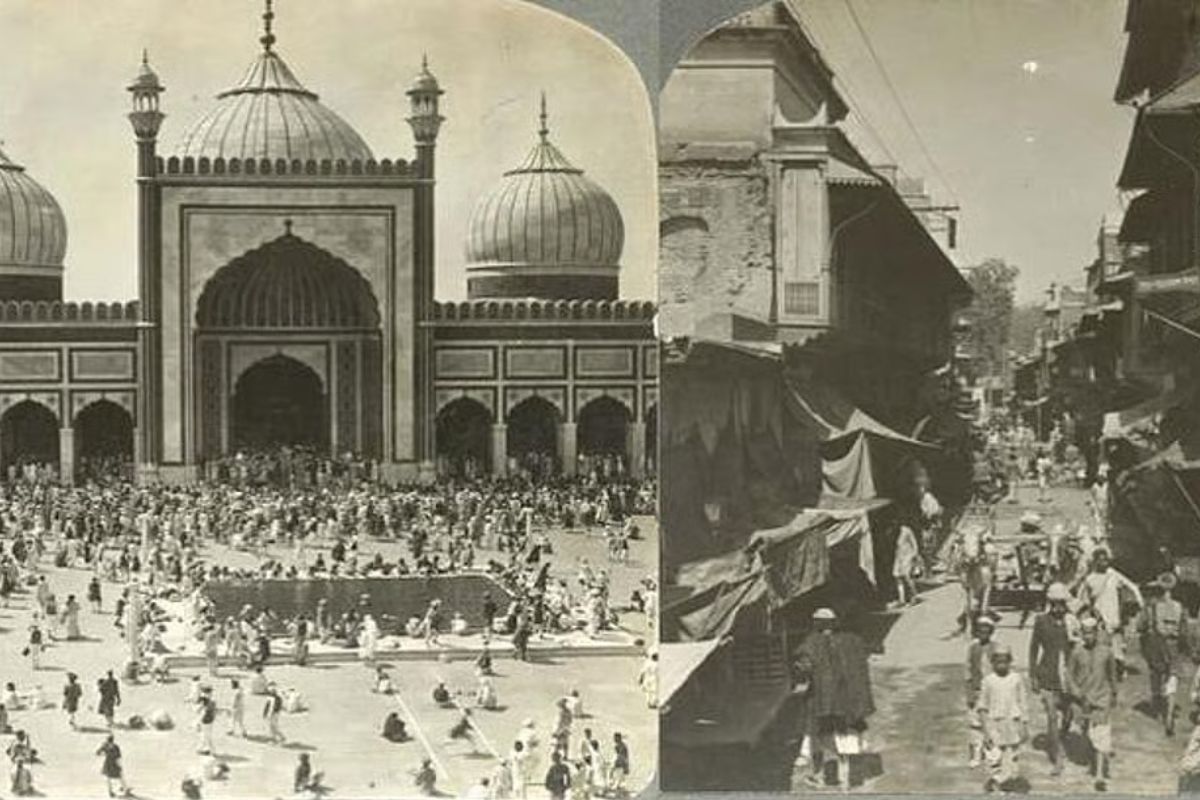
Of the seven cities, Shahjahanabad is the only one still inhabited in its original form, still commercially and residentially alive inside its Mughal street plan. Walk into old Chandni Chowk and you are inside a 17th-century city, though one buried under cable spaghetti and concrete overlays. The Red Fort is a UNESCO World Heritage Site; the Jama Masjid is the largest mosque in India; the havelis, though in decay, still define lanes that Shah Jahan’s planners laid out.
Dinpanah/Shergarh is Purana Qila — Old Fort — on the banks of the Yamuna. Sher Shah Suri’s massive walls and gateways still stand with considerable dignity, and the interior contains Humayun’s library and mosque, where the Emperor is said to have tripped on his robes and fallen to his death. The ASI has excavated a section of the interior lawn and confirmed continuous habitation across the Mughal, Suri, Lodi, and Tomar periods. The site is publicly accessible and criminally undervisited.
Firozabad, Firoz Shah Tughlaq’s capital, is today almost entirely absorbed into the Civil Lines area and ITO’s chaotic road network. Its most prominent remnant is Firoz Shah Kotla, where the Ashokan pillar still stands — cracked at its tip by an 18th-century earthquake — and where the underground chambers are inhabited every Thursday by devotees who come to leave offerings for djinns. This is Delhi in miniature: a 3rd-century BCE monument installed by a 14th-century sultan, now maintained by folk belief.
Tughlaqabad, Ghiyasuddin’s city, is the most photogenic ruin in Delhi and the most melancholy. Built with terrifying speed and abandoned within a generation — supposedly cursed by the Sufi saint Nizamuddin Auliya — its cyclopean rubble walls sprawl across a ridge in south Delhi, partially engulfed by a residential colony on one flank and a wildlife corridor on the other. Adilabad, the small fort Ghiyasuddin’s son built nearby, is in even worse repair.
Siri, Alauddin Khalji’s city, barely exists at all above ground. The Siri Fort Auditorium complex contains the most visible section of its walls, but most of the city is buried under the upscale South Delhi colony of Shiekh Sarai and Panchsheel Park. There are stretches of the old fort wall visible as overgrown mounds in neighbourhood parks, unidentified to most residents.
Lal Kot and its extension Qila Rai Pithora, the twin precincts of the first Delhi, are now fully subsumed within and around the Qutb complex. The Qutb Minar itself stands on the ruins of a pre-existing temple complex — the Quwwat-ul-Islam mosque was built using columns from at least 27 dismantled Hindu and Jain temples, whose carvings remain visible in the colonnades. Here the layering is not underground but eye-level and inescapable.
Space, Power, and the Politics of Foundation
Why did each new ruler build a new city rather than simply expand the old one? The answer tells us something profound about how power was imagined in medieval South Asia. A capital was not merely an administrative convenience — it was a cosmic statement. The decision to found a new city was an act of ritual and ideological self-definition.
Alauddin Khalji was not just building a garrison city in Siri; he was declaring himself the axis of a new order, one that had repelled the Mongols and could afford to transcend his predecessors’ geography. Muhammad bin Tughlaq’s Jahanpanah, which physically enclosed both Qila Rai Pithora and Siri within a single new wall, was an act of spatial annexation as much as construction — he was literally walling in history to contain it within his own narrative.
The orientation and topography of each city also encodes power. Tughlaqabad faces away from its predecessors, turned toward the Yamuna and the eastern plains — a military posture. Shahjahanabad faces inward, centering on the Red Fort’s private axis, a court city arranged around royal visibility and concealment. Firoz Shah’s Kotla is positioned on the river precisely to control river trade. Each city, archaeologists note, was built where it was for reasons that the ruins still articulate if you know how to read them.
The ASI’s Impossible Task
The Archaeological Survey of India operates under the Ancient Monuments and Archaeological Sites and Remains Act of 1958, amended significantly in 2010. The Act mandates a 100-metre “prohibited zone” and a 200-metre “regulated zone” around all centrally protected monuments — but Delhi has over 174 such monuments within a single, continuously urbanising metropolitan area. The zones overlap, are routinely violated, and are fiercely contested in court.
The ASI is understaffed to a degree that would be shocking if it were better publicised. A single circle office responsible for monitoring dozens of sites might have four or five field officers. The Heritage Conservation Committee, which was meant to provide municipal-level oversight, has had an uneven record of enforcement. Meanwhile, private construction continues to go underground — basements are now standard in Delhi residential construction — with consequences for buried archaeology that are largely undocumented.
There have been genuine successes. The conservation of Humayun’s Tomb, completed in partnership with the Aga Khan Trust for Culture, is considered one of the finest restoration projects in Asia. The Mehrauli Archaeological Park is a remarkable concentration of medieval structures — including tombs, a mosque, and an octagonal tomb-platform — preserved within a public green space. But these are islands of protection in a sea of pressure.
A Walking Tour — Finding the Layers Yourself
Delhi’s archaeology is not only in museums. It is on the surface, if you know where to look.
Begin at the Qutb Complex in Mehrauli, where you can stand inside Lal Kot and touch a pillar repurposed from a Gupta-period temple while looking at a minaret begun in 1193. From there, walk or drive north into the Mehrauli Archaeological Park, entering through the gate near the Adham Khan tomb. The park contains over 70 medieval structures, most unlabelled, set among babul trees and peacocks.
Next, drive east to Tughlaqabad. Walk the perimeter of the outer walls — they are partially accessible — and stand on the ramparts looking toward the cluster of high-rises at Saket. You are looking at land that was once this city’s agricultural hinterland. The tomb of Ghiyasuddin Tughlaq, connected to the fort by a causeway over what was once a lake, is a masterclass in austere Tughlaq geometry.
Then north to Siri: the walls near the auditorium complex. Stop at the Hauz Khas complex, which was Alauddin’s enormous reservoir and later, under Firoz Shah, flanked with a madrasa and tombs. The deer park beside it was reclaimed from what was once a Tughlaq hunting ground.
Continue to Purana Qila. Walk through the Humayun-era gateway, examine the excavated trench in the lawn, and sit inside Sher Mandal — the octagonal tower from whose steps Humayun fell in 1556. Then east to Firoz Shah Kotla, where you should arrive on a Thursday evening to see the djinn-worship in the underground chambers. It is not theatre. It is living religion in a medieval ruin, which is about as compressed an image of Delhi’s layers as you will find.
End in Shahjahanabad: enter the old city through the Turkman Gate, walk north toward Jama Masjid through lanes that have not changed their geometry in 375 years, and find a spot to simply stand and listen. The city is still talking, if you know it is speaking several languages at once.
Delhi is not one city with a long history. It is many cities occupying the same coordinates, each one a commentary on the ones before. The archaeologists digging under your colony road are not excavating the past. They are recovering the argument.