


With the Left Democratic Front voted out of Kerala in 2026, it is time for a clear-eyed retrospective on what decades of communist governance actually produced — its genuine miracles, its stubborn failures, and the irreversible stamp it left on the idea of Indian democracy.
The 1957 Beginning — EMS and the Land That Changed Everything
On April 5, 1957, Elamkulam Manakkal Sankaran Namboodiripad — known to history simply as EMS — was sworn in as the Chief Minister of Kerala, becoming the head of the world’s first democratically elected communist government. The significance of this moment can barely be overstated.
In the middle of the Cold War, while the United States and Soviet Union were locked in an existential ideological contest, a small, coastal Indian state had gone to the ballot box and chosen Marx — peacefully, through universal adult franchise, with full international scrutiny. It was, by any measure, one of the most extraordinary electoral events of the twentieth century.
EMS inherited a state that was, on paper, desperately poor but intellectually rich. Kerala had benefited enormously from Christian missionary education and the reformist movements of the nineteenth century — the Sree Narayana Guru’s egalitarian renaissance among the lower castes, the Nair Service Society’s progressive push, the Syrian Christian community’s long association with literacy. This was a society already primed for radical social change. What EMS gave it was the legislative instrument.
The Kerala Agrarian Relations Bill of 1959 was the centrepiece of his government’s ambition. In a state where absentee landlordism was endemic and tens of thousands of poor agricultural labourers worked land they would never own, the bill attempted to cap landholdings, give tenants security of tenure, and redistribute surplus land to the landless.
It was, in essence, an attempt to end feudalism by statute. The Central government — alarmed both by its radicalism and by pressure from entrenched property interests — dismissed the EMS government under Article 356 before the bill could fully take effect, in what became known as the “liberation struggle” of 1959. Jawaharlal Nehru’s own daughter, Indira Gandhi, then Congress president, actively campaigned for the dismissal. It was a moment that revealed the limits of parliamentary communism in a federal democracy — and also, perhaps, the fear it inspired.
But EMS returned. And when the Left came back to power, the land reforms that finally passed in 1969 — under the government of C. Achutha Menon — were among the most sweeping in Indian history. Tenancy was abolished. Land ceilings were imposed. Hutment dwellers received ownership rights. Millions of agricultural labourers received a form of economic dignity that their counterparts in Bihar or Uttar Pradesh could not imagine for another generation. It was imperfect, litigated for decades, and only partially implemented — but it broke the back of feudal Kerala in a way that no other Indian state managed through democratic means.
The Kerala Model — How a Poor State Outgrew Its GDP
For decades, economists and development scholars were baffled by Kerala. Here was a state whose per capita income was unremarkable by Indian standards, whose industrial output was modest, and whose public finances were perpetually strained — and yet whose human development indicators rivalled those of middle-income European nations.
By the 1980s, Kerala’s literacy rate was approaching 100%. Its infant mortality rate had fallen to levels that made the rest of India look medieval by comparison. Its birth rate had declined sharply — not through coercive sterilisation campaigns as in parts of India during the Emergency, but through female education and agency. Life expectancy had risen to match that of much wealthier societies.
This became known in academic literature as the “Kerala Model” — the idea that redistribution, investment in public goods, and social mobilisation could deliver human development independent of rapid economic growth. Harvard economist Amartya Sen, who would go on to win the Nobel Prize, held Kerala up as evidence that development was fundamentally about expanding human capabilities, not merely accumulating national income. The World Bank studied it. The United Nations cited it. UNICEF used it as a template.
What produced this? The answers are multiple and contested, but the Left’s contribution was real and specific. Successive Left governments massively expanded the public health infrastructure — the network of government hospitals and Primary Health Centres that reached into every taluk and panchayat. They invested in a public education system that, at its best, was genuinely excellent and accessible to children of every caste and class.
They strengthened the Public Distribution System, ensuring food security even for the very poor. And perhaps most crucially, they empowered organised labour — the trade unions that the CPI(M) built gave agricultural and factory workers a negotiating power that translated directly into higher wages, better conditions, and a sense of social respect that money alone cannot purchase.
The land reforms created a class of small landowners with something to protect and something to aspire to. This, combined with mass literacy, gave Kerala a society that was fundamentally more equal than almost anything else on the subcontinent. Female literacy, which the Left prioritised explicitly, became the single most powerful driver of Kerala’s demographic transition — educated women had fewer children, those children were better nourished, and the cycle of intergenerational poverty was broken within two generations.
The Criticisms — When the Model Started Curdling
No honest retrospective can avoid the other side of the ledger. For all the glory of the Kerala Model, the Left’s governance produced structural pathologies that accumulated over decades into a serious crisis.
The most enduring criticism concerns Kerala’s relationship with private enterprise. The Left’s ideological hostility to capital — expressed through aggressive trade unionism, restrictive labour laws, and an administrative culture that was suspicious of business — created an environment where investment was chronically underweight relative to the state’s human capital.
Kerala produced some of the most educated workers in India; they then left for the Gulf, for Bangalore, for the United States, because there was not enough productive enterprise at home to employ them at their skill level. The great irony of the Kerala Model is that it created human capital of extraordinary quality and then exported it. The remittances that flowed back — estimated at over ₹1.5 lakh crore annually at the peak — sustained household consumption and propped up the very social indicators that development economists praised, while masking the underlying failure to build a productive economy.

The fiscal record is equally troubling. Kerala has been, for most of its history, a high-spend, high-debt state. The Left’s political economy depended on a large and well-compensated public sector workforce — a constituency that became both loyal and expensive.
By the 2010s, Kerala’s revenue expenditure on salaries, pensions, and interest payments consumed such a large fraction of its budget that capital investment — roads, ports, industrial infrastructure — was perennially squeezed. The state became trapped in a cycle where borrowing funded current consumption rather than future productivity, and where the political cost of rationalising the public sector was simply too high for any government to pay.
The suppression of private sector dynamism had one further consequence that is rarely discussed: it made Kerala unusually dependent on sectors — government employment, remittances, tourism, cashew and spice exports — that were either finite or volatile. When Gulf employment slowed, the anxiety was palpable. When monsoons failed, the agricultural sector that land reforms had created had no resilience. The Left built an admirable safety net but never built the economy underneath it.
The 2016–2026 Chapter — Vijayan’s Decade of Ambition and Contradiction
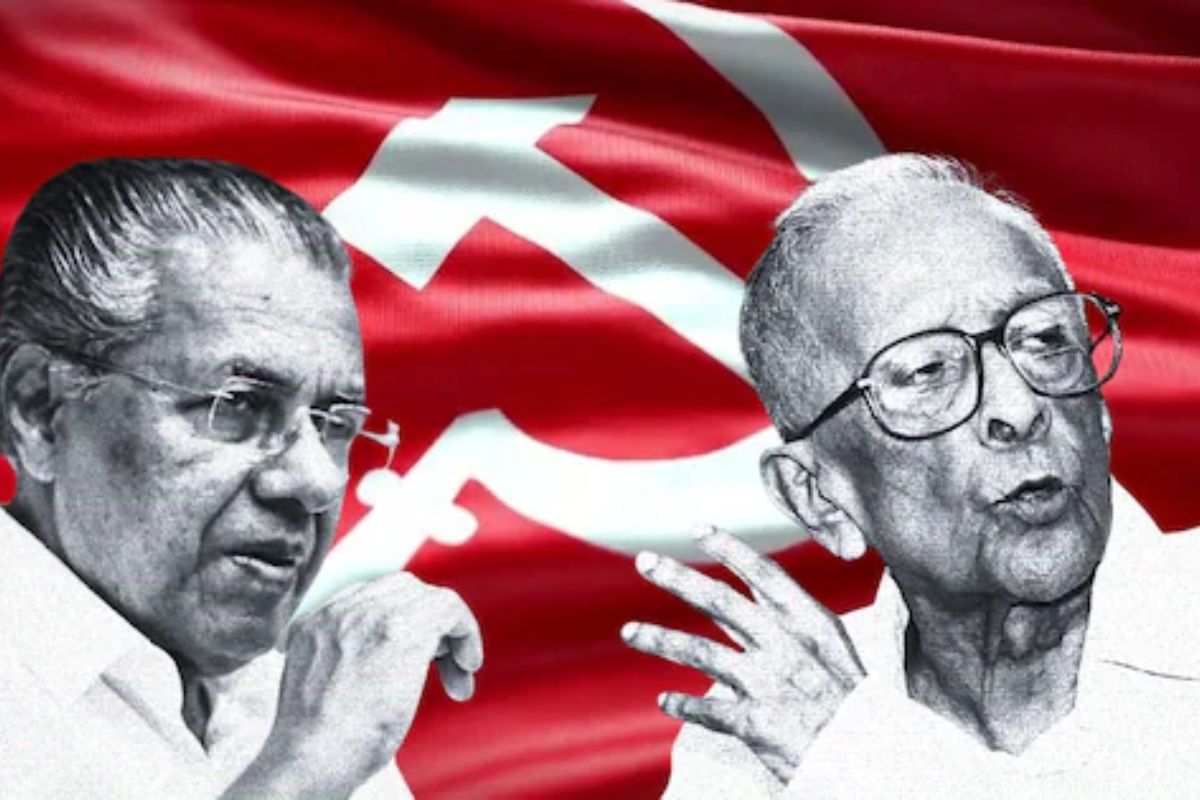
When Pinarayi Vijayan led the CPI(M) to a decisive victory in 2016, ending a decade of Congress-led UDF rule, he arrived with the image of a strongman — disciplined, unsentimentally efficient, ideologically orthodox but pragmatically flexible. His decade in power produced a genuinely mixed record that defies easy summary.
On the credit side, Vijayan’s response to Kerala’s serial disasters — the catastrophic floods of 2018 and 2019, the Nipah virus outbreaks, and the COVID-19 pandemic — was widely acknowledged as among the most competent disaster management in India.
The state mobilised quickly, communicated clearly, and leaned on its public health infrastructure in ways that saved lives and generated global admiration. The Rebuild Kerala initiative and the digitisation of government services were genuine administrative advances.
Infrastructure, long neglected, received greater attention. The Kochi Metro expanded. The SilverLine semi-high speed railway project was announced with ambition, though it became deeply controversial — environmentally, fiscally, and politically — and exposed the Left’s growing difficulty in navigating between its developmental instincts and the ecological sensitivities of an urbanising middle class that it had itself educated.
But the decade also hardened the criticisms. Corruption scandals multiplied — the gold smuggling case that implicated figures close to the Chief Minister’s office, the Life Mission housing scandal, the K-Rail controversy — and they chipped away at the Left’s most precious political asset: its reputation for institutional integrity relative to Congress.
The administrative machinery, once a point of pride, showed signs of politicisation and fatigue. And the fiscal situation, despite Vijayan’s rhetoric of transformation, did not fundamentally improve. Kerala’s debt burden continued to climb. The Centre’s disputes with the state over borrowing limits added to the pressure.
The Long Decline — Why Young Keralites Voted Differently
The generation that came of age after 2010 knew Kerala’s communist chapter not as history but as ambient furniture — the red flags, the hartals, the party offices on every junction, the trade union presence in every workplace. They grew up in the Kerala Model’s success but also in its stagnation. They were literate, aspirational, globally connected, and frustrated.
The brain drain that economists had long documented now had faces and Instagram accounts. Young Keralites who left for Bangalore or London or Dubai were not fleeing poverty — they were fleeing the absence of opportunity at home. They returned for festivals and family occasions but increasingly saw their home state as a place of sentiment rather than possibility. When they voted — or when they shaped the opinions of those who remained — they brought with them the impatience of people who had seen what a functioning market economy could produce.
The Left’s cultural politics also alienated segments of Kerala’s diverse religious communities. The CPI(M)’s management of its relationship with both the Sangh Parivar and certain Islamic organisations had grown increasingly complicated, generating accusations of opportunism from multiple directions. Political violence in Kerala — particularly in Kannur, the CPI(M)’s stronghold — remained a stain that the party never fully addressed.
The 2026 verdict was not a repudiation of everything the Left built. It was a generational statement that the model had reached its productive limits — that the next chapter of Kerala’s development required a different political imagination.
What India Can Learn — And What It Cannot Simply Borrow
Kerala’s communist chapter offers India something invaluable and something cautionary in equal measure.
The invaluable lesson is that investment in public goods — education, health, nutrition, social security — is not a luxury that only rich states can afford. Kerala proved, over seventy years, that a poor society can deliberately choose to be an equitable one, and that equity itself becomes a development accelerant.
Female education, in particular, produced returns so large and so durable that they humiliate every argument for postponing it. States like Bihar and Uttar Pradesh, which have the GDP that Kerala lacked and the human development indices that Kerala achieved, represent not an alternative path but a failure of political will.
The cautionary lesson is equally important. The Kerala Model cannot be copy-pasted without also replicating the social and historical conditions that made it possible — a pre-existing culture of reform movements, a high degree of social mobilisation, strong civil society institutions, and an educated electorate capable of holding government accountable.
In states where none of these conditions exist, a left government without a mobilised society produces not the Kerala Model but something closer to West Bengal under the later CPM — bureaucratic inertia, political patronage, and the gradual strangulation of productive enterprise without the compensating gains in human development.
The deeper lesson may be this: the Kerala Left’s greatest achievement was not any particular policy but the long project of building a society in which citizens understood their rights and demanded their entitlements. That civic consciousness — the willingness to strike, to organise, to litigate, to vote out governments that disappoint — is Kerala’s most durable export.
It is what the rest of India needs most urgently. And it cannot be installed by legislation. It has to be grown, over generations, through exactly the kind of patient, unglamorous investment in human beings that Kerala’s communists — at their best — actually made.
The red flag has come down in Thiruvananthapuram. But the revolution it imperfectly represented — the idea that ordinary people deserve health, education, dignity, and a state that serves them — remains the most important unfinished business in Indian democracy.