



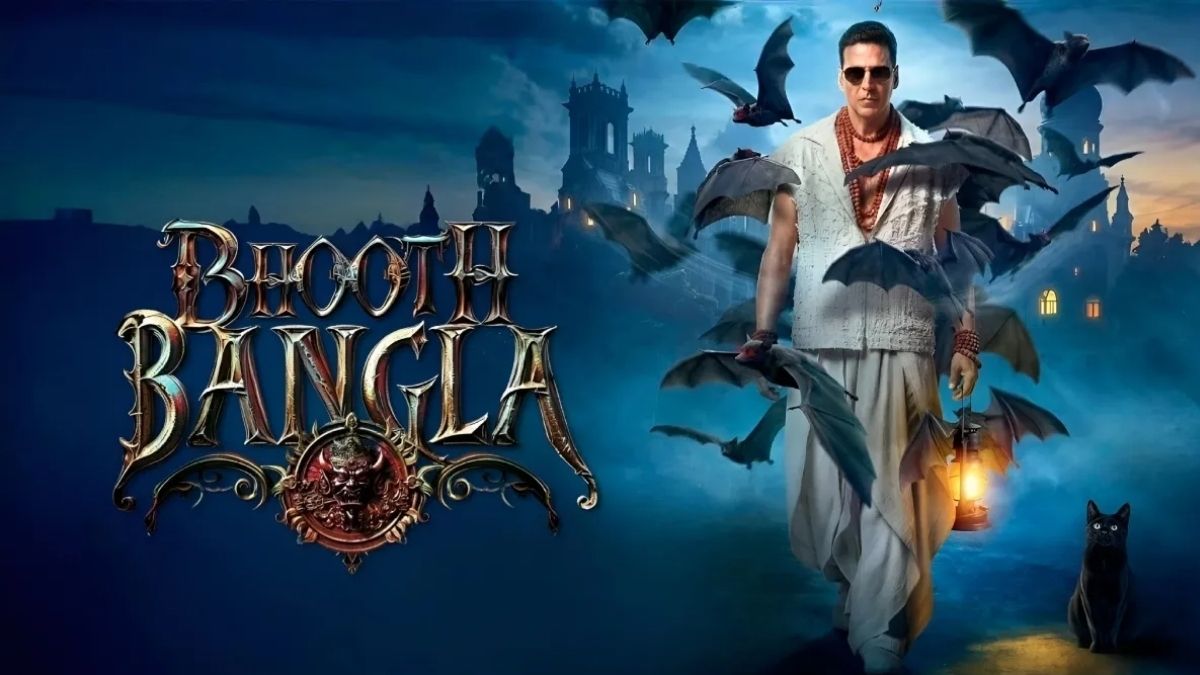
Let’s establish something upfront, because you deserve it: you are not here because a promotional reel featuring a saffron-draped Akshay Kumar doing a slow-motion walk through a crumbling haveli convinced you of anything. You are here precisely because it didn’t. You’ve clocked the Instagram reels, absorbed the motion posters plastered across Delhi and Jaipur like a civic art movement, and watched approximately forty-seven seconds of the official trailer before your instincts kicked in and you said, “Okay but what is this film actually?” That is a healthy response. That is film literacy in action. And that is exactly what this guide is for.
So — let’s talk about Bhooth Bangla, which released in cinemas on April 17, 2026, and has already done ₹94 crore at the box office, making it the third-highest-grossing Hindi film of the year so far. The numbers are not the point. The question is whether any of those tickets should be yours.
First, Get the Director Right — Because He’s the Whole Argument
Bhooth Bangla is directed by Priyadarshan, which is the single most important sentence in this entire guide. If you are reading this and thinking, “Who?” then we need to do some remedial work before we go further.
Priyadarshan is the Malayalam cinema veteran who brought you Hera Pheri, Hungama, Hulchul, Malamaal Weekly, and — most relevantly — Bhool Bhulaiyaa (2007). That last film remains one of the most skillfully constructed horror-comedies Bollywood has ever produced, a film that managed to be genuinely creepy in its second half while having been genuinely hilarious in its first. If you have watched Bhool Bhulaiyaa and felt like it worked, you have already calibrated yourself to what Priyadarshan’s horror-comedy template looks like. Bhooth Bangla is operating in that same zip code.
This is not the post-modern meta-horror of Munjya. It is not the atmospheric dread of Tumbbad. It is certainly not the jump-scare assembly-line product that a certain subset of OTT thrillers has normalized. Bhooth Bangla is Priyadarshan’s second Hindi-language horror-comedy following Bhool Bhulaiyaa (2007), and it reunites him with Akshay Kumar, Paresh Rawal, Rajpal Yadav, Asrani, and Manoj Joshi — essentially the entire original repertory company. This is a reunion project in the truest sense, not unlike getting the original cast of a beloved stage show back under one roof, nineteen years older, slightly more padded around the middle, and still knowing exactly how to time a pratfall.
The Priyadarshan lineage matters because his brand of horror-comedy is rooted in farce, mythology, and ensemble chaos rather than atmospheric tension. His scares arrive not through cinematographic darkness or ominous silence but through escalating absurdity — the kind where you find yourself laughing and startled in the same breath, not because the ghost was scary, but because the situation became so unhinged that dread and delight collapsed into the same emotion. Understanding this before you buy your ticket saves you from sitting in the dark, arms crossed, waiting for something that was never going to come.
The Story, Shorn of Its PR Spin
Bhooth Bangla is the story of madness in a haunted house. Arjun Acharya, played by Akshay Kumar, lives in London with his sister Meera and his father Dr. Vasudev Acharya. When Meera is set to marry, the family needs a destination in India for the wedding. At this point, Arjun and Meera learn that their grandfather has passed away in the town of Mangalpur, a grandfather they didn’t even know was alive. They also learn they are now heirs to his palatial residence — and Arjun, ever the optimist, immediately flies to Mangalpur, convinced the dilapidated haveli can be restored into a wedding venue.
If that plot synopsis triggers a Pavlovian response — some deep cellular memory of Bhool Bhulaiyaa, Haunted Mansion (the American version), or basically every Scooby-Doo episode ever made — you are not wrong. The haunted-inheritance setup is as old as storytelling itself. What Priyadarshan does with the architecture matters more than the architecture itself, and here he has loaded the premise with significant mythological weight: the film is a horror-comedy based on Indian mythology and black magic, with inspiration drawn from ancient texts such as the Vedas and the Mahabharata. This is not decorative texture. The mythology-as-horror framework is what separates the Priyadarshan school from the Stree school — one uses folklore as a cultural lens, the other uses it as emotional infrastructure.
The dual-role angle is also worth noting. Both Akshay Kumar and Wamiqa Gabbi play double roles, which in a Priyadarshan film is almost never just a gimmick. The duality feeds directly into the mythology and black magic framework — questions of identity, possession, and ancestral burden tend to manifest in exactly this kind of narrative architecture.
The Cast: A Master Class in Ensemble Warfare
The starcast includes Akshay Kumar, Wamiqa Gabbi, Tabu, Paresh Rawal, Rajpal Yadav, Mithila Palkar, Asrani, Jisshu Sengupta, Manoj Joshi, and Rajesh Sharma. That is not a cast list. That is a parliamentary session of comedic and dramatic authority.
Let’s break this down with some honest accounting.
Akshay Kumar is doing something he hasn’t done in years — working inside a director’s vision rather than being the director’s vision. Priyadarshan is one of the few filmmakers who has historically been able to subordinate Kumar’s star power to genuine character work, which is why their collaborations (Hera Pheri, Bhool Bhulaiyaa) remain career-defining for both of them. This marks their reunion after fourteen years since Khatta Meetha (2010), and the chemistry of familiar creative partnership tends to produce more relaxed, lived-in performances. Whether that holds here is for you to judge, but the preconditions are right.
Tabu is a different conversation entirely. Tabu in a Priyadarshan horror-comedy is not a supporting player. She is a gravitational field. Her work in Bhool Bhulaiyaa — if you’ve watched it — functioned as the film’s emotional and dramatic fulcrum; without her, the whole exercise would have been enjoyable chaos rather than something that actually landed. Her presence in Bhooth Bangla signals that Priyadarshan has again built a role demanding that specific quality she has: the ability to make you laugh and then, minutes later, make your skin prickle. The fact that she agreed to return to this genre with this director after nearly two decades says something about what she read on the page.
Wamiqa Gabbi has been one of the more quietly compelling performers in Hindi cinema over the last few years — Jubilee, Sapta Sagaradaache Ello, Sam Bahadur — and her presence here is an upgrade over what you might expect from a “female lead in a Bollywood horror-comedy.” She is not decorating the frames. She carries half the film’s dual-identity weight.
And then there is the triumvirate: Paresh Rawal, Rajpal Yadav, and Asrani. These three men, together, constitute the entire comedic genome of a specific golden era of Hindi film comedy. Paresh Rawal as a wedding planner from Karol Bagh is exactly the kind of casting that makes critics sound like they’re writing fan mail, because it is perfect casting. Rajpal Yadav operating in a haunted-house context is essentially a genre unto himself. Asrani, now in his eighties, still doing this — that is not nostalgia. That is a man who understands his craft so completely that age becomes irrelevant to its execution.
Throw in Mithila Palkar (charming, grounded, a reliable emotional anchor), Jisshu Sengupta (bringing the gravitas of Bengali cinema to what could have been a throwaway father role), and a cameo by Shehnaaz Gill, and you have a film that is, at minimum, never boring to look at.
What the Critics Are Actually Saying, Translated
The reviews have landed in that diplomatically useful range that critics call “mixed” and films call “audience will decide.” Let’s translate the consensus into plain language.
The Times of India awarded the film 3 out of 5 stars and observed that while the first half is thoroughly entertaining and keeps audiences hooked, a crisper narrative and shorter runtime would have made the horror-comedy far more effective. The screenplay turns messy, the creatures and some set pieces come across as gimmicky in places toward the climax, and the second half loses steam and sharpness.
India Today rated it 2.5 out of 5, concluding that the film falls short of delivering the expected blend of horror and comedy, struggling with outdated humour, weak storytelling, and lacking the excitement audiences hoped for.
Bollywood Hungama was more generous with 3.5 out of 5 stars, highlighting that the film works best for its humour, performances, and overall entertainment value.
Triangulated, the honest verdict is this: the first half is fun, the second half is shaky, the performances elevate the weaker material, and it will not retroactively change your memory of Bhool Bhulaiyaa. That last point is important. If you are going in hoping to be blown away — to experience the specific electric surprise of Bhool Bhulaiyaa’s third act — temper that expectation to about sixty percent of what you’re imagining and you’ll leave satisfied rather than deflated.
The film does what Priyadarshan films have always done well and stumbles where they have always stumbled: the comedy infrastructure is immaculate, the horror scaffolding is sometimes more wobbly than it should be, and the climax reaches for epic when it should perhaps have reached for intimate.
The Sonic Architecture: Pritam and the Arijit Singh Story
Pritam composing the score is quietly significant. This is not a man who writes filler. His horror-comedy instincts — the way he scored Bhool Bhulaiyaa’s iconic Aami Je Tomar — are deeply calibrated to Priyadarshan’s rhythms. The soundtrack’s second single, “Tu Hi Disda,” came with an unusual backstory: singer Arijit Singh, who had earlier announced his exit from playback singing, approached the makers specifically to perform the track, saying he felt a strong personal connection with it. That is not a promotional anecdote. That is a musician overriding a professional decision because the song asked something specific of him. Songs that do that tend to be worth hearing.
The ₹400 Question: Theatre or OTT?
Here is the honest calculus. Bhooth Bangla is, at its core, an ensemble comedy with horror seasoning, and ensemble comedies are among the few genres where the theatrical experience genuinely adds value. The laughter of a crowd is a participatory instrument — it shapes the rhythm of how you receive comedy in ways that a living room cannot replicate. Paresh Rawal’s timing lands differently when it lands on eighty people simultaneously.
The second half’s reported weakness in pacing is also the kind of thing that a good audience can paper over, and the kind of thing that your phone’s screen will make worse. Watching a film you find slightly dull in a cinema is an inconvenience. Watching the same film on OTT when you can pause it is the death of a thousand cuts.
If you enjoy this genre — if Bhool Bhulaiyaa, Golmaal, Hera Pheri occupy real estate in your affections — go to the cinema. This film was built for that room. If you are someone who primarily watches on OTT and horror-comedy is not a native language for you, wait. It will arrive on a streaming platform soon enough, and the first half alone will justify the watch without the ticket cost making it feel like a wager.
But if you have been waiting, even half-heartedly, for Priyadarshan and Akshay Kumar to remind you what their partnership is capable of? The answer to that question is not going to come through a phone speaker. It is going to come in a darkened hall, surrounded by people who are going to laugh at Rajpal Yadav long before you will, which will make you laugh at yourself for laughing at Rajpal Yadav, which is the whole magic trick, isn’t it?
Buy the ticket.