


The invitation of a party arrives, as these invitations always do, at approximately 11:47 PM on a Tuesday, through a WhatsApp group whose name has not been updated since it was created for a friend’s bachelorette in 2022. The message is a Canva graphic — coral and black, pleasingly designed, with a font that is doing significant creative labour — and it announces, with the full confidence of someone who has never been let down by a crowd: Y2K NIGHT. THIS SATURDAY. DRESS CODE STRICTLY ENFORCED.
There is always a dress code. It is never strictly enforced. But we will get to that.
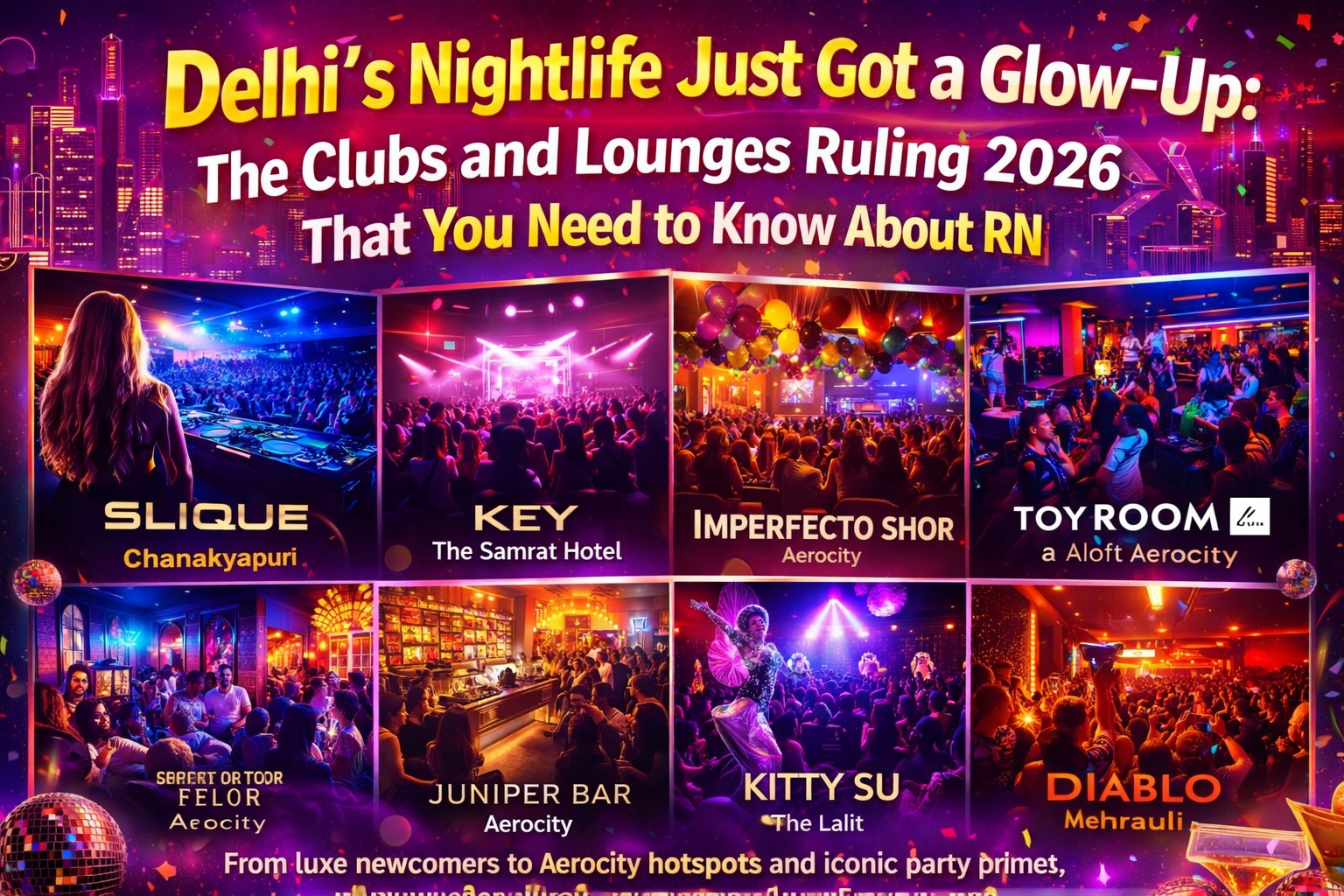
The themed party has become, in the past two years, one of Delhi’s more insistent social phenomena. Not just the occasional costume night that happens around Halloween or a particularly enthusiastic birthday, but a whole calendar of curated, concept-driven evenings that have colonised the weekends of anyone between twenty-five and thirty-eight with enough disposable income and social anxiety to keep saying yes. Y2K nights. Bollywood villain parties. “Mob wife aesthetic” evenings (this is a real theme; we will discuss it). Dark academia gatherings. “If you were a font, what font would you be” parties — no, actually, that one hasn’t happened yet, but the ecosystem is trending that direction. Give it six months.
What these events have in common is a pitch that is, on paper, very appealing: a room full of people who all tried to dress the same way, dancing to music that is thematically coherent, in a venue that has usually done something interesting with its lighting. The promise is collective creativity. The reality is something considerably more complicated, more funny, and, if you are the kind of person who finds social spectacle entertaining rather than exhausting, considerably more enjoyable than the pitch suggests.
I have been to several of these. Here is what actually happens.
The Costume Gap: An Iron Law of Themed Parties
There is a sociological principle that I have observed across every single themed party I have attended in the past eighteen months, and it goes like this: exactly thirty percent of any given room will have committed to the theme with a seriousness that borders on the professional. Another forty percent will have made a gesture in the theme’s direction — a relevant accessory, a colour palette that rhymes with the brief, a hairstyle that is doing thematic heavy lifting while the rest of the outfit does nothing at all.
And the remaining thirty percent will have simply arrived in whatever they were planning to wear anyway and will, when asked about their costume, say either “I’m dressed as myself” (this is never as charming as the person saying it believes) or something that requires a three-sentence explanation to connect to the theme (“it’s Y2K but like, the darker, underground side of Y2K, which is more of a vibe than a look”).
The thirty percent who have committed are, without exception, the most fun people in the room. At the Y2K night I attended — held on a rooftop in Vasant Kunj, strung with silver fairy lights, with a playlist that opened on Destiny’s Child and slid decisively through early Britney — these were the people in genuine low-rise jeans, with butterfly clips excavated from actual 2001 childhoods, wearing the kind of rhinestone tops that were never comfortable and were never meant to be.
One woman had arrived in a full Aaliyah-era baggy-bottoms-crop-top-bandana configuration that was so accurate it was briefly destabilising, like seeing a historical photograph animate. A man near the bar had committed to a Justin Timberlake-Justified-era denim-on-denim situation that was either a masterclass in costume commitment or the most elaborate irony I have ever encountered. Possibly both simultaneously.
These people saved the party. Not because the thirty percent who didn’t dress up made the party bad — a room full of people who are slightly awkward about their lack of costume is still a room full of people, and rooms full of people, given sufficient music and a functional bar, tend to find their way to fun eventually. But the thirty-percenters are the visual architecture of the evening. They are the proof that the theme was real, that someone took it seriously, that the Canva graphic meant something. Without them, a Y2K night is just a party where the DJ plays older music than usual.
The Music: What It Promises and What It Delivers
Here is where themed parties in Delhi in 2026 are doing their most interesting and most uneven work. The playlist is always the backbone of the concept. It is also, remarkably often, the place where the concept first shows signs of structural stress.
A Bollywood villain party — a theme I encountered at a basement venue in Lado Sarai that had been decorated with red lightbulbs and, inexplicably, a framed portrait of Shakti Kapoor — promises, logically, an evening anchored in the great villain-coded songs of Hindi cinema’s golden age. Gulshan Grover. Pran. The whole magnificent, twirling, leering tradition of the Bollywood bad guy. And the first forty-five minutes delivered exactly this: “Woh Saat Din” into “Main Hoon Don” into a stretch of Amjad Khan material that had the committed thirty percent doing genuinely unhinged dance moves that were, I think, meant to evoke menace but came across as deeply endearing.
Then, at approximately the ninety-minute mark, something happened that happens at every themed party regardless of the theme. The DJ, sensing that the crowd’s energy needed to be sustained rather than educated, made a turn. “Besharam Rang” came on. Then “Jhoome Jo Pathaan.” Then, in a move that I can only describe as a complete thematic capitulation, Dua Lipa. The Bollywood villain party had, by midnight, become a regular Bollywood-and-pop party with ambient red lighting and an unusually high number of people in sherwanis.
Nobody complained. This is the other thing that always happens: the crowd, almost without exception, goes along with the drift. There is a kind of collective relief when the theme releases its grip and the evening becomes simply an evening. The costumes are still on. The vibe is still distinct. But the music has found its equilibrium, which is: whatever will keep people dancing, in service of whatever will keep people in the room. Themes, it turns out, are for starting parties. Music is for sustaining them.
The Mob Wife Aesthetic Night: A Special Case Study
I want to dwell on this one because it is, of all the themed nights I attended in the course of reporting this article, the most conceptually fascinating and the most genuinely Delhi thing I have ever experienced.
The mob wife aesthetic — for the uninitiated — is a trend that originated on TikTok in approximately 2023-24 and refers to a specific visual vocabulary: maximalist fur (usually faux), oversized gold jewellery, dark lips, dramatic eyeliner, the general energy of a woman who is aware that her husband’s business dealings do not bear close examination and has decided to spend the money anyway. It is confident, it is slightly intimidating, and it translates, in the context of a party theme, to an invitation to wear the most aggressively glamorous thing in your wardrobe and then add more jewellery to it.
The room at this particular event — held at a private members-adjacent space in Greater Kailash, the kind of place with a members list that nobody talks about openly — was, I am not exaggerating, one of the most visually spectacular things I have witnessed at any social event in this city. South Delhi women, it turns out, do not need to be told twice to dress glamorously.
They needed to be told once, on a Canva graphic, and they arrived in ensembles that suggested their wardrobes had been waiting for exactly this permission. Fur stoles over silk. Diamonds — some real, some aspirationally real — at every possible attachment point. Dark lip colours with names like “Vamp” and “Russian Roulette,” worn with the conviction of women who have committed to the bit entirely.
The men, predictably, were in suits. A few of the more enthusiastic ones had added what appeared to be pocket squares intended to signal mobster affiliation. One man wore a fedora. It was fine. The men at themed parties are, as a gender, perpetually at the gesture-toward-the-theme stage rather than the theme-fully-executed stage, and the mob wife night was no exception. The women carried the concept. The men provided the audience.
What made this evening specifically Delhi, though, was not the costumes — it was the conversation. Because Delhi has, genuinely and without irony, a class of people for whom the mob wife aesthetic is not entirely fictional. Not in the criminal sense — though Delhi’s drawing rooms have always contained people whose money has interesting provenance — but in the sense that the combination of significant wealth, political adjacency, ostentatious display, and a certain comfort with power that doesn’t fully explain itself is simply… a recognisable social type here.
The theme, in other words, hit differently in this city than it would have in, say, Pune. There was a layer of recognition beneath the camp, a knowing quality to the way people inhabited the costume, that made the whole evening feel like a very elegant joke that only people from Delhi would fully get.
Whether the Theme Survives the Crowd
Honestly? Never fully. Always partially. And the partial survival is, I would argue, the point.
A themed party that successfully enforced its theme — that turned away the thirty percent who hadn’t dressed up, that cut the playlist off from anything not period-accurate, that maintained total conceptual coherence from the first arrival to the last Uber — would be an immersive theatre experience. It would be interesting, probably, and also quite exhausting.
The leakage is what makes it a party. The moment when someone in full Y2K rhinestone is having a conversation with someone in regular jeans about something entirely unrelated to the late 1990s is not a failure of the theme. It is the party achieving its actual purpose: getting people who might not otherwise have met into the same room, in slightly heightened versions of themselves, and then letting what happens next happen.
The costume is a social lubricant. This is its primary function. When you show up to a Y2K night in actual platform shoes, you have done something vulnerable and a little ridiculous, and that vulnerability is the fastest route to conversation with strangers who have also done something a little ridiculous. The theme lowers the activation energy for talking to people you don’t know, because the thing you are all doing together — being a bit silly, taking a bit of care, agreeing to play — is immediately shared ground. You do not need to have anything else in common. You were both willing to show up.
This is why the themed party has proliferated in post-pandemic Delhi specifically. The city has an abundance of people who want to be social and a shortage of easy, low-stakes formats for meeting people outside their existing networks. The themed event offers the format. The costume does the rest.
A Few Practical Observations, Since We’re Being Honest
The bar queue is always longer than it should be. This is a universal truth, but it is especially true at themed parties, where the bar area tends to attract people who are slightly overwhelmed by the sensory experience of being surrounded by costumes and need a drink immediately and for structural reasons.
The best conversations happen in the venue’s transitional spaces — the stairwells, the area immediately outside the bathroom, the corner near the speaker that is loud enough that you have to lean in to hear someone but not so loud that conversation is impossible. The middle of the dance floor is for dancing. The edges are for meeting people. The transitional spaces are for the conversations you’ll actually remember.
At least one person will ask to take a photograph of your costume for their Instagram story. This is the themed party’s version of a standing ovation. Accept it graciously.
The theme will, at approximately midnight-thirty, release its grip on the music and the dress code simultaneously, and the party will briefly feel like any other party — which is its signal that it has succeeded. A theme that remains rigidly itself all evening is a concept. A theme that softens into a party is an event.
Attend the former for the Instagram content. Attend the latter for the evening itself.
The Verdict, With Caveats
Delhi’s themed party moment is real, it is here, and it is more fun than it has any right to be, for a reason that has nothing to do with the themes and everything to do with the city. Delhi, as a social organism, performs. It has always performed. Its relationship to display — of wealth, of taste, of personality, of effort — is not incidental to its character; it is its character.
The themed party gives that performative instinct a structure, a direction, and a deadline. The result, when the right thirty percent show up in full costume and the DJ reads the room correctly and the bar queue is only slightly too long, is one of the better evenings this city offers.
Which is saying something. Delhi’s bar for an evening is high. And on a Saturday night in 2026, dressed in something you would never normally wear, in a room full of people who made a similar choice, the bar is, improbably, being cleared.
The Canva graphic was right. The dress code was not strictly enforced. Both of these things were, in the end, exactly correct.