



The ice cream you grew up with is lying to you. Not in a dramatic way. Just in the quiet, industrial way that something with seventeen ingredients and a six-month shelf life lies — by existing comfortably in a category it does not deserve.
It is 43 degrees in Delhi right now and the city is not handling it gracefully, which is the correct response to 43 degrees. But somewhere in this chaos, a very specific and very satisfying revolution has been quietly happening in Delhi’s frozen dessert landscape — and it has nothing to do with the Baskin-Robbins at Select Citywalk, the Keventers your parents still have an emotional relationship with, or any multinational chain that arrived in India with its flavour names already decided in a boardroom in New Jersey.
We are talking about the underground. The small-batch churners, the cloud kitchen ice cream operations run out of home freezers and obsessive conviction, the brands that operate via Instagram and pray their packaging survives the Dunzo delivery. The spots that don’t have menu boards in most cases — or if they do, the menu changes before you can memorise it. This is the ice cream ecosystem that Delhi’s most chronically curious eaters have been building quietly for the past five years, and in April 2026, with the city sweating through its third consecutive heatwave alert, it has never been more necessary.
Here is your map to it. Save this. Share it. Open it while standing in front of your fridge at midnight weighing your options.
Why Small-Batch Ice Cream Is Having Its Moment Right Now
Before we get to the specifics, it’s worth understanding why this ecosystem exists at all — because it didn’t, not really, ten years ago.
The catalyst was a combination of three things arriving at roughly the same time in India’s urban food market. The first was the Instagram discovery machine, which gave micro-food brands the ability to build a devoted audience of several thousand followers without ever paying a single rupee in marketing, as long as their product photographed beautifully and their founder had a story worth telling. Ice cream, it turns out, photographs magnificently.
The second was the cloud kitchen infrastructure that exploded post-2019 and accelerated through the pandemic years — the realisation that you did not need a physical retail presence to run a food business, just a production space, a Swiggy and Zomato listing, and packaging that survived the last mile delivery. For ice cream specifically, this created an interesting logistical challenge that the best brands solved with insulated packaging and carefully managed delivery zones. The brands that figured out the cold chain without compromising the product are the ones still standing today.
The third was a very Delhi-specific shift in how the food-conscious consumer thought about what they were eating. The post-pandemic urban Indian in their late twenties became extraordinarily interested in ingredients — not in a neurotic, label-reading anxiety way, but in a genuine curiosity about whether the things they put in their body were actually the things they thought they were. This created a natural audience for ice cream that could tell you exactly what is in it, because the person who made it also sourced every ingredient themselves.
The result is a scattered, delightfully chaotic ecosystem of artisanal frozen dessert operations across Delhi that collectively represent a genuinely different philosophy about what ice cream is supposed to be.
Artiste: The One That Started Asking Uncomfortable Questions About Sugar
Artiste has dedicated itself, in its own words, to changing the way you experience ice cream, creating its product in small batches with precision and passion. This sounds like marketing language until you actually try the Chilli Guava and understand that no industrial ice cream factory produced this particular flavour combination with this particular level of conviction.
Artiste is handcrafted from honey and jaggery instead of white sugar, 100% fresh cow milk, and fresh and natural fruits. The practical consequence of this choice is that the ice cream tastes different — not in a “healthy substitute” way that usually means disappointing, but in a genuinely distinctive way. Honey and jaggery have flavour profiles that white sugar does not. When they carry a Rose Saffron ice cream or a Fig and Balsamic variant into existence, those are not just flavour names. They are actual flavour experiences, because the base itself is not a neutral vehicle.
The flavour range at Artiste includes Alphonso Mango blended with avocado (described as your daily source of Vitamin C and good fat), Chilli Guava, Tender Coconut with fresh coconut milk topped with finely shredded coconut, and an extensive range including Rose Saffron, Blueberry Cheesecake, Arabica Coffee, and Double Dark Chocolate. Over 31 variants at last count, which for a small-batch operation is a genuinely remarkable commitment. They serve ice cream in clay pots — a detail that sounds like aesthetic theatre until you realise that clay is a natural insulator, which keeps your ice cream slightly more intact between scoop and mouth in a city that is currently trying to melt everything.
Artiste is available on Swiggy and Zomato and has outlets across Delhi. The ice cream is not cheap — this is a premium product priced accordingly — but the price buys you something that the supermarket freezer aisle cannot: specificity. Every scoop tastes like someone decided what it should taste like and made it happen on purpose.
Prerna’s Handcrafted Ice Cream: The Lockdown Origin Story That Actually Has a Happy Ending
Every ice cream underground has a founding myth. In Delhi’s case, one of the most compelling belongs to Prerna Puri — an interior designer turned ice cream entrepreneur whose entry into the business began, as the best food businesses often do, with making something for her children.
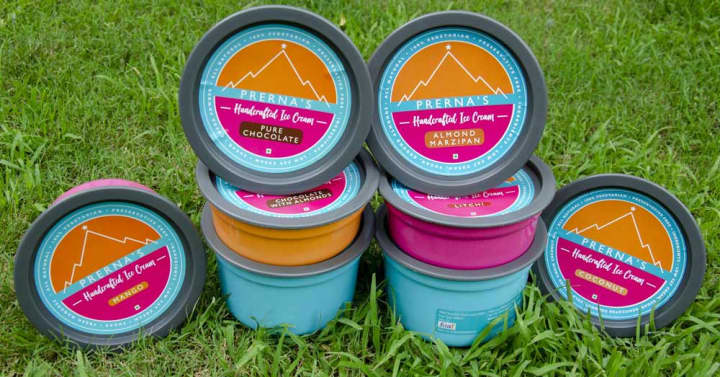
A graduate of the National Institute of Fashion Technology who was working as an interior design consultant before the pandemic, Prerna began making ice cream at home during the lockdown and received such positive feedback from family and friends that she approached Modern Bazaar — the premium retail chain in Delhi — to stock it. They agreed. The brand now produces 35 to 40 tonnes of ice cream with 16 employees, and revenue had touched Rs 7 lakh per month.
Prerna’s Handcrafted Ice Cream is available across Modern Bazaar and organic stores in Delhi and NCR. The flavours include Almond Marzipan, Coconut, Coffee Walnut, Pure Chocolate, and Strawberry, with seasonal additions. The 250 ml tub starts at Rs 350 and the 500 ml at Rs 650.
What makes Prerna’s particularly interesting as a model is the distribution strategy — not a cloud kitchen play, but a premium retail stocking approach that bypasses the logistics complexity of delivery while targeting exactly the consumer who walks into a Modern Bazaar looking for something they feel good about buying. The no-preservatives commitment means the fruit flavours stay for just 20 days in a commercial freezer and other flavours up to 60 days — which means every tub you buy is genuinely fresh in a way that commercial ice cream almost never is. That shelf life constraint, which sounds like a limitation, is actually the quality guarantee.
NOTO and Minus 30: The Cloud Kitchen Ice Cream That Actually Works
The cloud kitchen ice cream model is harder than it sounds. The last-mile problem — the way ice cream experiences existential crisis between the packing station and your door — has killed several promising delivery-only operations in Delhi over the past few years. The brands that have survived have done so by solving the cold chain problem with expensive insulated packaging and disciplined delivery zone management.
NOTO is a brand that proves that dessert does not necessarily have to be associated with guilt, with low-calorie ice creams, vegan options, and even healthy mithai. The positioning is smart because it captures the person who wants ice cream but has spent too many evenings reading about sugar’s various crimes against the human body to order it without calculation. NOTO gives them the calculation’s outcome before they do it themselves. The vegan range in particular has found an audience in Delhi’s growing plant-based community — not the preachy kind, just the kind that has genuinely discovered that oat milk ice cream, done properly, does not taste like a compromise.
Minus 30 offers only online delivery service — no physical outlet, no walk-in option, entirely operating through delivery platforms and its own ordering channels. Prepared with fresh fruits and free of artificial flavours, each bite is full of flavour. The name is a reference to the temperature at which ice cream is ideally stored — a detail that tells you something about the brand’s priorities. You order from Minus 30 not because you happened to walk past it, but because someone told you about it and you went looking. That discovery mechanism — word of mouth, Instagram, a friend’s recommendation — is the entire marketing strategy, and for a certain kind of Delhi food consumer, that scarcity of visibility is itself a recommendation.
Kakigori: The Japanese Chapter Nobody Saw Coming
Here is the wildcard in Delhi’s artisanal frozen dessert ecosystem, and it is the one that consistently startles people who discover it for the first time.
Kakigori is a shaved ice cream dessert made of ice and toppings of your choice, and this is India’s only Kakigori chain. They serve 15-plus flavours, from fruity to dairy-free, and the toppings include everything from googly eyes and gems to choco chips and other additions.
Kakigori is a Japanese tradition — shaved ice served with flavoured syrups and toppings, with a history stretching back over a thousand years in Japan, where it was originally a luxury available only to aristocracy during summer. The Indian version retains the essential character of the original: the ice is shaved so fine it becomes almost cloud-like in texture, collapsing gently rather than crunching, and the flavours soak into it rather than sitting on top. The result is genuinely unlike any frozen dessert you have had before, and in 43-degree Delhi weather, the cloud-in-a-cup quality hits differently.
The dairy-free options make Kakigori unusually inclusive in a city with a significant population that avoids dairy, and the visual presentation — which photographs beautifully — has made it a consistent presence in Delhi food circles’ Instagram content. But the taste justifies the visit independently of the photograph.
Cold Love: The One the Restaurants Trust
Cold Love sells all-natural ice cream without preservatives and artificial colours or flavourings. It has two shops in Delhi and offers home delivery. Several of Delhi’s best restaurants offer Cold Love ice cream on their dessert menu.
That last detail is the important one. When a restaurant with a considered food philosophy puts Cold Love on its dessert menu rather than making its own or defaulting to a commercial brand, it is making a statement about what it thinks ice cream is supposed to be. Cold Love has become, in Delhi’s food service ecosystem, a signifier — the ice cream a kitchen trusts to represent it at the end of a meal it has otherwise cooked from scratch. That is not an easy reputation to build.
The two physical outlets mean you can walk in, which gives Cold Love a slightly different character from the pure delivery operators — it occupies the interesting middle position of being genuinely artisanal while being reliably accessible.
How to Actually Navigate the Underground (The Part Nobody Tells You)
The practical reality of Delhi’s artisanal ice cream ecosystem is that it operates according to rules that are slightly different from the ones you use to navigate the rest of the food world. Understanding those rules saves you the experience of opening Swiggy at 11 p.m. and being confused about why your options feel limited.
The first rule is that Instagram is the directory. Every serious small-batch operation in Delhi maintains an Instagram account with more information about what they do, what they’re currently making, and how to get it than any food delivery app listing will give you. The app listing exists for ordering convenience. The Instagram account is where the brand actually lives. Follow the accounts, turn on notifications if you’re serious about a particular brand, and treat the stories as your real-time menu.
The second rule is that seasonality is real and should be respected rather than argued with. Prerna’s makes Mango and Litchi as seasonal flavours — they exist when the fruit is right and don’t when it isn’t, and this is the correct approach. Artiste’s Alphonso Mango variant with avocado is similarly anchored to the moment when Alphonso mangoes are actually Alphonso mangoes and not the imposters that appear in supermarkets in December. When a small-batch brand tells you a flavour is seasonal, it means the alternative is a worse version using inferior ingredients — and a brand with their level of commitment would rather not make it at all.
The third rule is that shelf life consciousness is a feature, not a complaint. When Prerna’s tells you the fruit flavours last 20 days and the others last 60 days, the correct response is to adjust your ordering behaviour accordingly — buy for the week, not for the month. This is how fresh food works, and the underground ice cream ecosystem is unapologetically fresh food.
The fourth rule is to be patient with delivery. The insulated packaging that keeps artisanal ice cream alive during last-mile delivery adds to the cost and occasionally to the delivery time. The brands that get this right have usually invested significantly in their packaging. Order during cooler parts of the day when possible — early evening rather than 3 p.m. in the current April heat — and give the brand the benefit of the doubt on arrival temperature.
The Bigger Picture: Why This Ecosystem Deserves Your Attention
The underground ice cream scene in Delhi is not just about better ice cream, though it is absolutely about better ice cream. It is about a generation of Delhi food entrepreneurs who decided that the terms of the industrial food market did not apply to them — that you could build a real food business on real ingredients, honest about their limitations, priced to reflect their actual quality, and distributed through channels that allowed the product to reach the people who would appreciate it.
Prerna Puri started making ice cream for her son. Artiste started asking why sugar had to be the base of everything. NOTO started asking whether healthy and delicious had to be opposites. Minus 30 started asking whether a physical location was actually necessary. Kakigori started asking whether Delhi was ready for a thousand-year-old Japanese tradition served in a paper cup.
The answer to all of these questions, in April 2026, in a city baking at 43 degrees and looking for something cold and true to put in its mouth, is an emphatic yes.
Open Instagram. Find these people. Order something that wasn’t made in a factory. And do it before the flavour sells out, because it will.
Artiste Handcrafted Ice Cream is available on Swiggy and Zomato and at select outlets across Delhi. Prerna’s Handcrafted Ice Cream is stocked at Modern Bazaar and organic stores across Delhi-NCR. NOTO and Minus 30 operate on Swiggy and Zomato. Cold Love has outlets in Delhi and delivers via food platforms. Search Kakigori on Zomato for your nearest location.