


There is a drink sitting on a bar counter in Delhi’s GK2 right now that costs roughly ₹500, looks like something a master bartender has spent fifteen minutes constructing, and contains exactly zero millilitres of alcohol. It is called the Sober Picante. It tastes — by multiple accounts — like the best version of a Picante you have ever had. And the person who ordered it is not a recovering alcoholic, not pregnant, not on medication, not driving, and not particularly interested in explaining themselves to anyone.
They are just a 26-year-old in Delhi who has decided, with the calm confidence of someone who has genuinely thought about it, that they do not want to drink tonight. And they still want something worth drinking.
This is the mocktail moment, Delhi edition. It has been building quietly for two years. In April 2026, with the city running at 43 degrees and a generation of young Delhiites who are rethinking their relationship with alcohol — not dramatically, not evangelically, but just thoughtfully, the way you rethink anything when you realise it isn’t serving you anymore — it has arrived.
First, Let’s Talk About Who This Person Actually Is
Because the conversation about “sober drinking” in India has, for too long, been conducted as if the only people interested in non-alcoholic options were the ones who had no choice — the designated driver, the religious observer, the person who simply does not drink. That version of the non-alcoholic bar customer still exists, and deserves to be served brilliantly. But they are no longer the only version, or even the primary one.
According to the IWSR Drinks Market Analysis, the no- and low-alcohol sector grew by over 7 percent globally in 2023, with non-alcoholic spirits leading the charge. This movement, driven by millennials and Gen Z, is gaining momentum in India. These are individuals who want to have a good time paired with well-crafted drinks, minus the hangover that often accompanies alcoholic cocktails.
In Delhi specifically, this person has a profile that is quite distinct from the teetotaller of a previous generation. They are probably in their mid-to-late twenties. They work in a sector that has adopted wellness vocabulary fluently — tech, consulting, media, startups. They track their sleep. They have an opinion on seed oils. They go to the gym before the 43-degree heat makes outdoor exercise a medical liability.
They have been to enough brunches and late nights to have done the calculus on what alcohol does to the two days that follow it, and they have decided, on at least some occasions, that it isn’t worth it. But they still want to sit at a well-designed bar, hold something beautiful in their hand, and feel like a person who is out having a good time.
That specific desire — wanting the atmosphere, the craft, the social ritual of a bar, without the alcohol — is what Delhi’s best venues have started to respond to, seriously and with real creative investment.
Many mocktails have lower ingredient costs than alcoholic beverages, yet similar price points on menus, which means they can give high-margin options capable of contributing significantly to the bottom line. Offering a robust mocktail menu is a great way for a business to stand out by demonstrating creativity, and a signature mocktail can quickly become a fan favourite and boost word-of-mouth. The economics, in other words, make sense from both sides of the bar — for the venue, it is a high-margin product in an environment where margins are perpetually under pressure; for the customer, it is a full bar experience at a price that doesn’t require a second thought.
Here is where that intersection is happening in Delhi right now.
Somewhere Nowhere, GK2: The Speakeasy That Actually Gets It
Somewhere Nowhere is a Japanese-style speakeasy located in the heart of GK2. It dedicates almost 50 percent of its beverage menu to alcohol-free options, which include zero-sugar drinks designed to mimic the appearance and taste of traditional alcoholic cocktails.
Read that number again. Fifty percent. In a speakeasy — a format that is, by aesthetic and historical definition, associated with the romance of illicit booze — half the drinks menu is built around not drinking. This is either the most counterintuitive decision in Delhi bar history, or it is the most forward-thinking one, and the evidence suggests it is the latter.
The Sober Picante is the standout from the Somewhere Nowhere zero-proof menu. A classic Picante is a tequila-based cocktail with chilli heat, citrus brightness, and a cool finish — it is one of those drinks that is greater than the sum of its parts. The sober version at Somewhere Nowhere reportedly captures the same architecture: the heat, the acid, the cooling resolution.
What makes this remarkable is that alcohol is not just an intoxicant — it is a carrier solvent that transports flavour compounds in a way that water and juice cannot replicate exactly. Creating a genuinely satisfying zero-proof version of a complex cocktail requires understanding flavour layering at a sophisticated level. The fact that this speakeasy has done it across half its menu is the clearest indicator that Delhi’s bar craft has grown up.
The space itself — GK2, Japanese-inflected, the kind of venue that requires a little finding — is also part of the statement. This is not a “healthy café” with wellness messaging on the walls. It is a serious bar that has decided serious bartending does not require alcohol as the foundation of every drink.
Call Me Ten, Vasant Vihar: The Speakeasy That Orders Like a Culinary Kitchen
Popular as one of Delhi’s most well-regarded speakeasies, Call Me Ten in Vasant Vihar’s Priya Market is visited as much for its zero-proof drinks as for its cocktails.
The zero-proof menu at Call Me Ten is the kind that makes you read the ingredients list twice, not because it is confusing but because you are working out what those flavours are going to taste like together and you want to be right before you order.
The Tea Party features oolong tea, smoked pineapple juice, honey, kaffir lime, falernum syrup, and lime. The Red Notice brings together watermelon shrub, mint, rose, and basil soda. The Summer Mary is a riff on a Bloody Mary — tomato juice, shiitake, lime, sriracha, soy sauce, and cumin soda. And the Paloma Meets Picante features jalapeño honey demerara, sweet lime, coriander, and homemade grapefruit soda.
Stop for a moment on the Tea Party: smoked pineapple juice. This is not something you achieve by buying a carton from the supermarket. This is a deliberate technique — smoking a juice to introduce volatile aromatic compounds — applied to a zero-proof drink in a speakeasy in South Delhi. The presence of falernum syrup (a Caribbean-origin syrup built from almond, lime, and spices) shows that the bar is sourcing specifically for its non-alcoholic menu, not using leftover ingredients from the cocktail station.
The Summer Mary is the choice for someone who wants maximum complexity in their glass. Shiitake mushrooms add umami depth that alcohol usually provides — the savoury, round quality that makes a drink feel substantial rather than thin. Cumin soda is something that sounds like a mistake until you try it and realise it is precisely the right call for a tomato-based drink made for an Indian palate. This is thoughtful, culturally intelligent bartending.
Price for two at Call Me Ten runs around ₹5,000 — positioning it clearly in the premium bracket, and making absolutely no apologies for it.
Home, Vasant Kunj: The Chakra Menu You Did Not Know You Needed
The beverage menu at Home in Vasant Vihar is designed as a musical journey, featuring drinks inspired by 12 different musical eras. While the alcoholic cocktails are to die for, the zero-proof cocktails — inspired by the seven chakras of the human body — are equally loved.
The chakra menu concept at Home is either the most Delhi-aunty thing ever done at a premium bar, or it is a stroke of creative genius that will look prescient in five years. The answer is probably both, simultaneously, which is very Delhi.
Standouts from the zero-proof menu include The Sensation, described as earthy and citrusy and made with apple, sweet lime, and beetroot kombucha. Flow Within, floral and spicy, combines red fruit, fennel, lemon, and soda. Solar Spark offers spicy jamun, apple, and jalapeños. Crown Light, described as creamy and floral, uses sober gin — a distilled non-alcoholic beverage designed to offer the taste and complexity of traditional gin without the alcohol — alongside lavender, citrus, and hung curd.
The Crown Light is the most technically interesting entry in this menu, and it is worth pausing on the ingredient “sober gin.” Non-alcoholic distilled spirits are a genuine product category that has arrived in global premium beverages — spirits that go through the same botanical distillation process as traditional gin, capturing the juniper, citrus, and herbal complexity, but with the ethanol removed through a process of vacuum distillation at low temperatures. The result is a liquid that carries gin’s flavour profile authentically, without the alcohol. Combining this with lavender, citrus, and hung curd produces a drink that would be interesting and complex in any category — alcoholic or not.
Beetroot kombucha in The Sensation is another marker of sophisticated sourcing. Kombucha itself brings carbonation, mild acidity, and a live-culture funkiness that works as a sophisticated mixer in ways that standard soda does not. The earthy sweetness of beetroot against the citric brightness of sweet lime creates a drink that occupies a genuine flavour space of its own, not a derivative space defined by what has been removed from it.
Home is located in Ambience Mall, Vasant Kunj, with a price for two around ₹5,500 — the top of the range for Delhi bar experiences, which means the ambiance and execution need to earn it, and by most accounts they do.
Sly Granny, Khan Market: The Most Delhi Name for the Most Delhi Zero-Proof Menu
Nested in Delhi’s Khan Market, Sly Granny’s zero-proof options include Barbarian Days (orange juice, passionfruit, mint, lemon, tonic water), Passion Fruit Orange Cooler (passion fruit puree, orange juice, fresh lime, and simple syrup), and The Botanist (lychee juice, jalapeños, rose, coriander, and soda water). For the experimentally inclined, Jungle Love features guava juice, basil, Granny’s hot sauce, Worcestershire sauce, and jalapeños — a memorable zero-proof cocktail by any measure.
Jungle Love is the order for someone who wants to understand what a properly composed non-alcoholic savoury cocktail actually tastes like. Worcestershire sauce in a drink sounds transgressive, but it is one of those ingredients — like fish sauce in a cocktail, or parmesan in a Bloody Mary — that contributes an umami base note which gives the whole thing structural weight. Without alcohol providing that body and warmth, savoury ingredients like Worcestershire and hot sauce step into the gap. Guava is the tropical brightness, basil is the herbal middle, and the jalapeños are the finish that keeps you coming back to the glass.
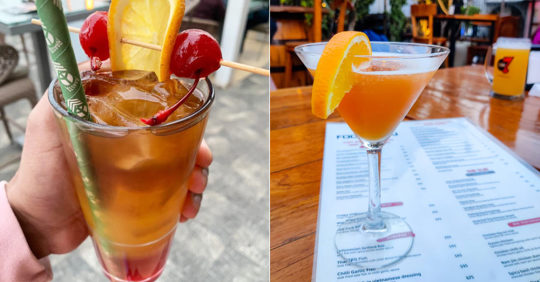
The Botanist — lychee, jalapeño, rose, coriander, soda — is the order for someone who wants the same layered complexity in a lighter, more floral register. Lychee and rose together are an obvious pairing in Delhi’s sensory vocabulary (the rosewater-and-lychee combination runs through mithai, sharbat, and now apparently premium zero-proof cocktails in Khan Market). Adding jalapeño and coriander gives it a green, slightly aggressive edge that stops it from being merely pretty.
Price for two at Sly Granny sits around ₹3,000 — a more accessible entry point into this world, and one that reflects Khan Market’s slightly earthier positioning relative to the Vasant Kunj and GK2 options.
The Brook, Gurugram: Where the Himalayas Pour Sober
The Brook in Gurugram is the second cocktail bar in Delhi NCR for award-winning mixologist Yungdup Lama, an ode to the Himalayas featuring cocktails and dishes that showcase indigenous ingredients from the region. The boghate — a tangy and layered drink featuring Himalayan pomelo, apple cider vinegar, Himalayan honey, and a dust of red chilli powder — is a favourite among visitors. Other must-try zero-proof cocktails include the basil spritzer, made with basil, elderflower, lime acid, and soda water, and the Tomato Hiball, featuring a tomato shrub, basil leaves, and soda water.
The Brook represents something philosophically distinct from the other bars on this list. While Somewhere Nowhere and Call Me Ten approach zero-proof drinks through the lens of Western cocktail culture — the Picante, the Paloma, the Bloody Mary — The Brook builds its non-alcoholic menu from ingredients that predate the concept of a cocktail bar entirely. Himalayan pomelo, local honey, chilli from mountain regions: this is a zero-proof drinks menu that is not referencing what it has removed, but what it has chosen to include.
The boghate’s use of apple cider vinegar is a technique borrowed from shrub-making — a colonial-era preservation method of combining fruit, sugar, and vinegar into a drinking syrup that creates a complex, acidic, sweet base with genuine depth. Himalayan honey is not a marketing descriptor; high-altitude honey from the Himalayan region has a distinct mineral quality and floral range that lowland honey does not. The red chilli dust finish is the elevation — a spice hit that lingers in a way that some spirits’ warmth would have provided, doing the same job through a completely different mechanism.
Price for two at The Brook sits around ₹3,000, and the Gurugram location makes it accessible for the Cyber City crowd who might not want to navigate central Delhi on a weeknight.
What This All Means for Delhi’s Drinking Culture
The bars in this list did not build serious zero-proof programmes because they felt obligated to. They built them because they looked at their customers, calculated the demand, understood the economics, and committed to doing it with the same craft they bring to their alcoholic menus. That commitment is the thing that separates what is happening here from the Virgin Mojito Era — the long, dreary period in Delhi’s bar history when the non-drinker was handed a glass of mint-muddled soda and told to be grateful.
The Virgin Mojito Era is over. In its place is something that deserves a better name than “mocktail” — a word that suggests a lesser version of a real thing, a shadow cocktail, an apology for not drinking. The bartenders building zero-proof programmes at Somewhere Nowhere and Call Me Ten and The Brook are not apologising. They are composing. They are thinking about acid and sweetness and bitterness and body and finish, and they are building drinks that occupy those dimensions fully, without alcohol as a shortcut to any of them.
For the 26-year-old in Delhi who does not want to drink tonight — for whatever reason, for no reason, for every reason — these places are not accommodating you as an afterthought. They are building menus around you. Pull up a stool. Order the Jungle Love. Tell them you’re not drinking.
You’ll still be holding something worth holding.